By [Yihang Brand] Technical Team · Read time: 10 min
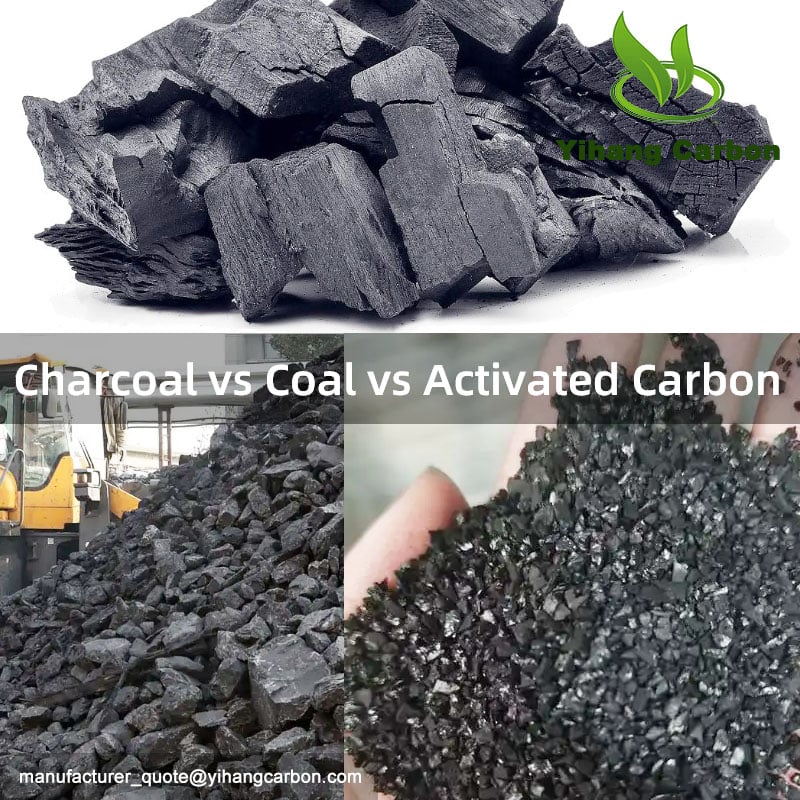
Lump charcoal, anthracite coal and finished 6×12 mesh granular activated carbon — same black element, three very different surface areas
Many industrial buyers mix up charcoal, coal and activated carbon. All three are black carbon‑rich materials, but they differ dramatically in raw material, manufacturing, pore structure, adsorption performance, price and HS customs codes.
You may search for “activated carbon for water treatment” and get listings selling lump charcoal or raw coal. Using the wrong material leads to failed filtration, wasted budget and unexpected project risks. As a professional activated carbon manufacturer, we break down their key differences, typical specifications, purchasing parameters and frequently‑asked questions to help you select the correct carbon product for your project.
Short takeaway:
-
Coal: Natural fossil mineral mined underground; mainly used as fuel. It can serve as feedstock for coal‑based activated carbon after carbonization + activation.
-
Charcoal: Man‑made carbonized biomass (wood, coconut shell etc), only carbonized without activation; low surface area, mainly used for fuel. It is the raw precursor for wood‑based / coconut‑shell activated carbon.
-
Activated carbon (also named activated charcoal): Carbonized feedstock (coal / wood / coconut shell) plus a high‑temperature activation step. Extremely high BET surface area (500‑1500+ m²/g), strong molecular‑level adsorption for water, air, gas, food and wastewater treatment.
Important note: “activated charcoal” and “activated carbon” mean exactly the same adsorbent. “Activated charcoal” is consumer‑oriented wording; “activated carbon” is industrial / ASTM standard terminology.
1. Raw Materials: Where Each Carbon Comes From
Charcoal — Renewable Biomass
Charcoal is produced from wood (hardwood logs, sawdust), bamboo, coconut shell or other agricultural residues. Raw material quality directly determines char yield and hardness — coconut shell produces the hardest, lowest-ash char, which is why it is the premium feedstock for water-treatment activated carbon.
Coal — Ancient Fossil Fuel
Coal forms from decomposed plant matter buried and compressed over 300+ million years. It is mined, not manufactured, in ranks from low to high carbon content:
| Lignite |
~60–70% |
16–19 MJ/kg |
Power generation |
| Bituminous |
~70–90% |
24–35 MJ/kg |
Power, coke for steel |
| Anthracite |
~90–95% |
32–35 MJ/kg |
Domestic heating, carbon feedstock |
Key point for buyers: bituminous and anthracite coal are common raw materials for coal-based activated carbon — but raw coal itself cannot adsorb. It must first be carbonised and then activated.
Activated Carbon — Charcoal That Went Further
Activated carbon is made from char of
coconut shell, coal or wood. Each feedstock creates a different pore structure:
-
Coconut-shell based: micropore-dominant, high hardness, low ash — drinking water, air, gold recovery
-
Coal-based: balanced micro/mesopores, high CTC activity — wastewater, industrial air, solvent recovery
-
Wood-based: macropore-rich — decolourisation of liquids, food & beverage processing
2. Production Process: One Extra Step Changes Everything
Charcoal Production — Carbonisation Only
Wood or shell is heated to 400–600°C in a low-oxygen kiln or retort. Volatiles (water, tar, gases) escape; a carbon skeleton remains. The process stops here. The result burns well — but its pores are largely closed and its internal surface is minimal.
Coal — Mining, Not Manufacturing
Coal requires no synthesis: it is extracted from mines, then crushed, washed and graded by size and calorific value. Its value is measured in heat, not surface area.
Activated Carbon Production — Carbonisation + Activation
This is where an activated carbon manufacturer earns the name:
Step 1 — Carbonisation: coconut shell, coal or wood is carbonised at 400–600°C to produce char.
Step 2 — Activation: the char undergoes one of two routes:
-
Physical (steam) activation: char is heated to 800–1,100°C and treated with steam/CO₂, which selectively burns disordered carbon from the inside, carving out millions of micropores.
-
Chemical activation: feedstock is impregnated with phosphoric acid or KOH, then heated at lower temperature — common for wood-based powder grades.
The result: internal surface area jumps from ~10–100 m²/g to 500–1,500+ m²/g. One gram of activated carbon can hold the internal surface of several tennis courts. No activation step, no activated carbon — regardless of what the label says.
3. Structure, Properties & Uses
Pore Structure Decides Function
| Micropores (<2 nm) |
Few, closed |
Almost none |
Highly developed — captures small molecules (chlorine, VOCs) |
| Mesopores (2–50 nm) |
Minimal |
None |
Engineered — traps dyes, larger organics |
| Macropores (>50 nm) |
Present |
Present |
Channels that guide molecules into the network |
| Surface area |
10–100 m²/g |
<10 m²/g |
500–1,500+ m²/g |
| Ash content |
2–15% |
5–30% |
2–15% (coconut shell lowest) |
Typical Applications: Match the Material to the Job
| Grilling / BBQ fuel |
✅ Primary use |
❌ |
❌ |
| Power generation / steel |
❌ |
✅ Primary use |
❌ |
| Drinking water purification |
❌ |
❌ |
✅ GAC, iodine ≥900 mg/g |
| Air / VOC / solvent recovery |
❌ |
❌ |
✅ Pellet, CTC ≥60% |
| Wastewater / decolourisation |
❌ |
❌ |
✅ PAC / wood-based |
| Gold recovery |
❌ |
❌ |
✅ Coconut-shell GAC |
| Soil amendment |
✅ Biochar form |
❌ |
❌ Over-engineered |
Need Activated Carbon?
Get Factory?Direct Pricing — No Middlemen
30 years manufacturing. MOQ 1 ton. Free samples. Reply within 1 hours.
4. Common Specifications
Charcoal and coal are traded on simple physical and thermal specs — size, moisture, calorific value. Activated carbon carries an engineered specification sheet — and this is the single most reliable way to verify you are buying a real activated product:
| Iodine number |
ASTM D4607 |
600–1,200 mg/g |
Micropore capacity — the #1 quality indicator |
| CTC activity |
ASTM D3467 |
40–100% |
Vapour-phase / solvent recovery capacity |
| Methylene blue adsorption |
GB/ASTM |
100–300 mg/g |
Mesopore capacity — liquid decolourisation |
| Apparent density |
ASTM D2854 |
0.38–0.55 g/cm³ |
Filter bed design |
| Ash content |
ASTM D2866 |
2–15% |
Purity, low ash = less contamination |
| Moisture |
ASTM D2867 |
≤5% |
Shelf life & dosing accuracy |
| Hardness / abrasion |
ASTM D3802 |
≥90–98% |
Long bed life, low dust |
| Particle size |
Mesh analysis |
See below |
Flow rate & contact time |
Standard particle sizes by form:
-
-
Powder (PAC): 100 / 200 / 325 mesh
-
Pellet / extruded: 1.5 mm, 2 mm, 3 mm, 4 mm diameter
-
Honeycomb / block: custom cell size
5. Key Buying Parameters (What to Check Before You Pay)
After 20+ years of manufacturing activated carbon, here is what separates a professional purchase from an expensive mistake:
1. Demand the iodine number — always. A supplier who cannot state the iodine number (ASTM D4607) is not selling filtration-grade material. For drinking water, specify iodine ≥900 mg/g; for air/VOC, specify CTC activity ≥60%.
2. Match the raw material to the contaminant. Coconut shell for micropore-dominated work (chlorine, gold, VOCs); coal-based for mixed wastewater and high-CTC applications; wood-based for decolourisation.
3. Verify the HS code on the invoice. Charcoal = HS 4402, coal = HS 2701, activated carbon = HS 3802.10. If your "activated carbon" shipment is declared as charcoal, you are paying $2,000/ton for $300/ton fuel.
4. Request documents before deposit: per-batch COA, third-party test report (SGS/BV), ISO 9001 certificate, and application-specific certifications — NSF/ANSI 61 (potable water), food-grade compliance, Halal/Kosher where required.
5. Ask for free samples and run a side-by-side test — adsorption capacity, dust level and hardness are immediately visible in a beaker test.
6. Compare total cost, not unit price. Low-priced "activated carbon" with iodine 600 mg/g needs 50% more dosage than iodine 1,000 mg/g material — the cheaper bag is the more expensive filter.
6. Frequently Asked Questions -FAQ
Is activated carbon made from coal or charcoal?
Both. Activated carbon is produced by activating char derived from coconut shell, wood or coal. Coal-based activated carbon starts from bituminous/anthracite coal that is first carbonised, then steam-activated. The feedstock determines pore structure — not the adsorption principle.
Can I use coal or BBQ charcoal instead of activated carbon in a water filter?
No. Raw coal and charcoal have surface areas below ~100 m²/g and contain ash, sulphur, tar and binders. They will not adsorb chlorine, VOCs or heavy metals — and briquettes can leach chemicals into your water. Only activated carbon with a verified iodine number (600–1,100 mg/g) performs in filtration.
What is the difference between carbonisation and activation?
Carbonisation (400–600°C, no oxygen) removes volatiles and creates the carbon skeleton — the result is charcoal. Activation (800–1,100°C with steam/CO₂, or chemical impregnation) burns away disordered carbon from inside the structure, opening the micropore network that delivers 500–1,500+ m²/g of surface area. Carbonisation makes fuel; activation makes an adsorbent.
Why is activated carbon more expensive than charcoal or coal?
You are paying for the activation step: energy-intensive kilns operating at 800–1,100°C, 30–50% material loss during activation, plus testing (iodine, CTC, ash, hardness) on every batch. Finished activated carbon ($800–2,800/MT) reflects engineering and quality control that fuel-grade materials ($50–400/MT) never receive.
Which activated carbon should I choose for my application?
Match the spec to the contaminant: coconut-shell GAC 8×30 / 12×40 mesh, iodine ≥900 for drinking water; coal-based pellet, CTC ≥60% for air and solvent recovery; wood-based or coal-based PAC, methylene blue ≥200 mg/g for wastewater decolourisation; coconut-shell GAC 6×12 for gold recovery. A real manufacturer will spec the grade from your target contaminant — not from a price list.
 EN