Sep 14,2026
In global CIP (Carbon‑in‑Pulp) and CIL (Carbon‑in‑Leach) gold extraction processes, the stability, adsorption capacity and mechanical attrition of coconut‑shell activated carbon directly impact mine gold recovery rates and annual consumable costs. As a key global metallurgical market, Africa has seen surging demand for high‑grade gold‑recovery activated carbon in recent years, with stricter requirements for batch‑to‑batch consistency, wear resistance and gold‑loading performance.
SunCarb‑Gold is an established Indian brand of gold‑grade activated carbon, widely adopted across African mines and well‑recognized by overseas mining operators. This article uses SunCarb‑Gold as a mature benchmark for parallel testing against YHGOLD GRADE 2000, a premium metallurgical‑grade coconut‑shell activated carbon. All comparisons are based on real‑world test data and objective analysis. It demonstrates that YHGOLD GRADE 2000 fully meets international first‑class standards for gold‑recovery carbon, delivers excellent performance across multiple key parameters, and serves as a reliable drop‑in alternative as well as a performance‑upgrade option.
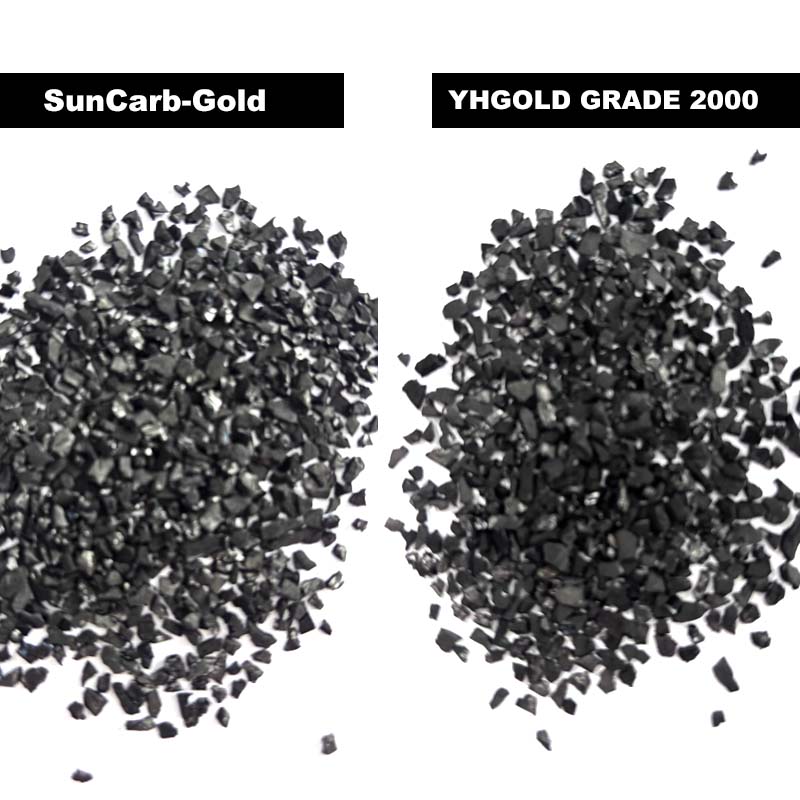
YHGOLD GRADE 2000 coconut shell gold recovery carbon — a cost-effective alternative to SunCarb‑Goldgrades.
This comparison covers ten critical dimensions commonly used for mine acceptance: particle size uniformity, hardness, ash content, moisture, iodine number, CTC, flat‑plate particle fraction, raw material, water‑immersion behaviour, and overall gold‑loading performance. All tests follow international mining specifications and ASTM testing protocols.
| Test Dimension | Industry Premium Standard | SunCarb‑Gold (Indian Import) | YHGOLD GRADE 2000 |
|---|---|---|---|
| Particle Size Uniformity | Narrow particle distribution, low fines generation | Properly sieved, uniform particles, stable under operating conditions | Multi‑stage precision sieving, narrower particle range, excellent consistency |
| Mechanical Hardness | ≥98% | 99% (Ball Pan method) | 98.6% (GB/T method) |
| Ash Content | ≤3.0% | 3.0% | 2.5% (SGS verified) |
| Moisture | ≤5.0% | Meets industrial specifications | <4.0% (SGS verified) |
| Iodine Number | 1050‑1200 mg/g+ | 1200 mg/g, high‑activity range for gold recovery | 1200 mg/g, well‑developed micropore structure |
| CTC | ≥60 | 60%, well‑activated | 62, superior total pore volume and activation depth |
| Flat‑Plate Particle Fraction | Low percentage preferred | 3% | 2.5%, fewer deformed particles |
| Raw Material | High‑quality coconut‑shell base | Local Indian coconut‑shell feedstock | 5‑year‑old mature Indonesian coconut shells, high‑purity base material |
| Water‑Immersion Behaviour | Clear water, fast sinking, uniform bubble release | Good washing quality, minimal floating fines | Crystal‑clear water, rapid settling, dense and long‑lasting bubble release |
| Overall Gold‑Loading Performance | Fast adsorption, high capacity, good regenerability | Proven performance in African mines | Combination of abundant micropores and large meso‑macropores, outstanding gold‑loading potential |
| K‑value (Gold Loading Capacity) | 1200iv range meets CTC 60 target | 31 kg/t | 31.5 kg/t |
| R‑value (Adsorption Rate) | 1200iv upper limit matches CTC 60 | 60% | 60% |
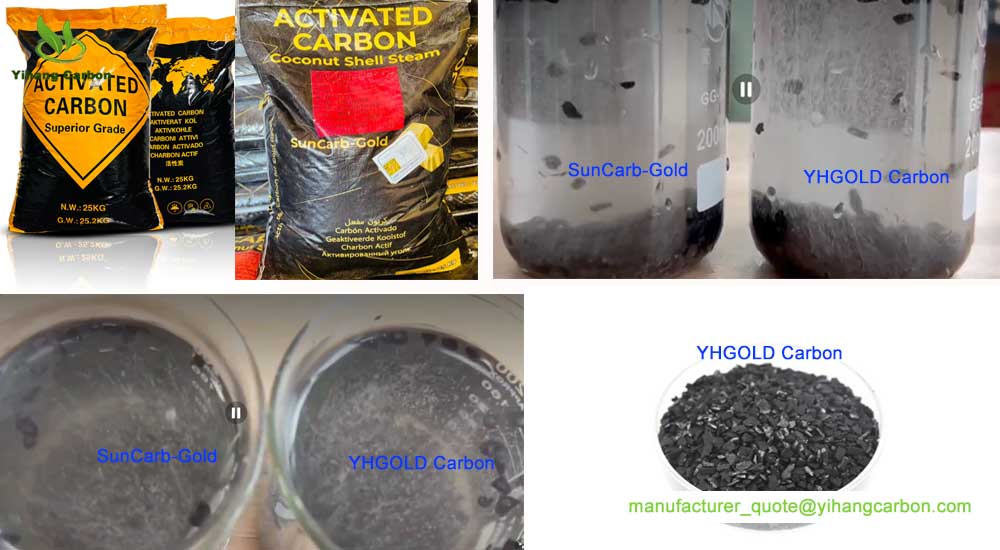
Bubbling and Settling test — rapid, complete particle sinking with minimal floating grains demonstrates high particle density and full activation maturity.
30 years manufacturing. MOQ 1 ton. Free samples. Reply within 1 hours.
As a mainstream imported carbon in African markets, SunCarb‑Gold features mature sieving processes and consistent particle uniformity. When loaded into CIL carbon beds, it maintains stable fluid resistance and controlled fines generation, with well‑proven real‑world performance.
YHGOLD GRADE 2000 adopts multi‑stage sequential sieving. For standard 6×12 mesh / 8×16 mesh / 5×10 mesh grades, it delivers a tightly concentrated particle distribution with 94‑96% particle pass‑rate, and low content of deformed particles and micro‑fines. While retaining equivalent operational stability, it achieves more uniform bed packing density and better wear control over long‑run continuous production.
SunCarb‑Gold meets hardness requirements and performs reliably under typical African agitation‑leaching conditions. It withstands repeated cycling in mining operations, with attrition within acceptable limits.
Thanks to high‑density coconut‑shell feedstock and stable carbonisation procedures, YHGOLD GRADE 2000 features dense particle structure and outstanding resistance to friction and breakage. Under intensive agitation and multiple regeneration cycles, it preserves particle integrity, helping reduce hidden gold losses caused by carbon fines.
Ash and moisture are fundamental hard parameters determining effective adsorption surface area. SunCarb‑Gold’s impurity levels comply with gold‑carbon industry standards and deliver stable performance across gold‑mine processing lines.
YHGOLD GRADE 2000 shows favourable measured figures: ash content < 3.0 % and moisture < 4.0 %. Lower ash minimises pore blockage and preserves accessible adsorption surface area. Lower moisture translates to higher effective carbon content, faster initial adsorption upon charging, and no redundant inert load. Batch‑to‑batch purity remains consistent.
Iodine number and CTC are key metrics for evaluating activation quality and pore‑structure development, and are mandatory for mine acceptance. SunCarb‑Gold is well‑activated; its iodine number and CTC fall within premium gold‑carbon ranges, providing sufficient adsorption capacity and pore structure for mainstream African mining operations.
YHGOLD GRADE 2000 delivers strong core adsorption parameters: iodine number 1200 mg/g and CTC ≥ 60. The high iodine number creates abundant micropore sites for capturing gold‑cyanide complexes. A CTC of ≥60 ensures sufficient meso‑macropore volume for fast mass‑transfer and higher saturation loading capacity. Its well‑balanced pore hierarchy delivers extra adsorption headroom for high‑concentration pulp and high‑throughput operations compared with conventional imported carbons.
Flat, deformed particles are mechanically weak and a major source of fines during operation. SunCarb‑Gold produces well‑formed particles with flat‑plate fraction kept within reasonable limits.
YHGOLD GRADE 2000 applies strict controls across forming, carbonisation and sieving to produce rounded, robust particles, with flat‑plate fraction below 3 %. This reduces particle breakage during prolonged agitation and extends stable carbon‑bed service life.
SunCarb‑Gold utilises local Indian coconut‑shell feedstock. Its stable base‑material quality underpins its long‑standing market position across Africa.
YHGOLD GRADE 2000 is manufactured from coconut shells harvested from 5‑year‑old mature Indonesian coconut palms. This feedstock inherently offers low ash, high density and high hardness. Combined with standardised carbonisation and gradient‑activation processes, it delivers consistent batch‑to‑batch performance for pore structure, hardness and impurity levels, with minimal performance fluctuation.
Water‑immersion testing is a rapid on‑site method for mines to verify washing quality and activation status. SunCarb‑Gold yields clear immersion water, normal settling and uniform bubble release, meeting standards for premium metallurgical carbon.
YHGOLD GRADE 2000 benefits from dedicated multi‑stage washing and de‑dusting procedures. Immersion produces crystal‑clear water with no floating dust. High particle density enables fast settling with almost zero floating particles. Fine, uniform bubbles are released for an extended duration, visually confirming well‑developed micropores and complete activation, indicating excellent adsorption activity.
SunCarb‑Gold has proven field performance at overseas mines, delivering reliable gold‑loading stability, adsorption kinetics and regenerability, earning high market recognition.
Supported by its high iodine number (1200 mg/g) and CTC ≥60, YHGOLD GRADE 2000 combines ample micropore adsorption capacity with open meso‑macropore mass‑transfer pathways. Its gold‑loading capacity and adsorption rate reach international premium gold‑carbon levels. It exhibits limited performance decay after regeneration and excellent full‑life‑cycle efficiency, fully matching the performance standards of leading imported brands.
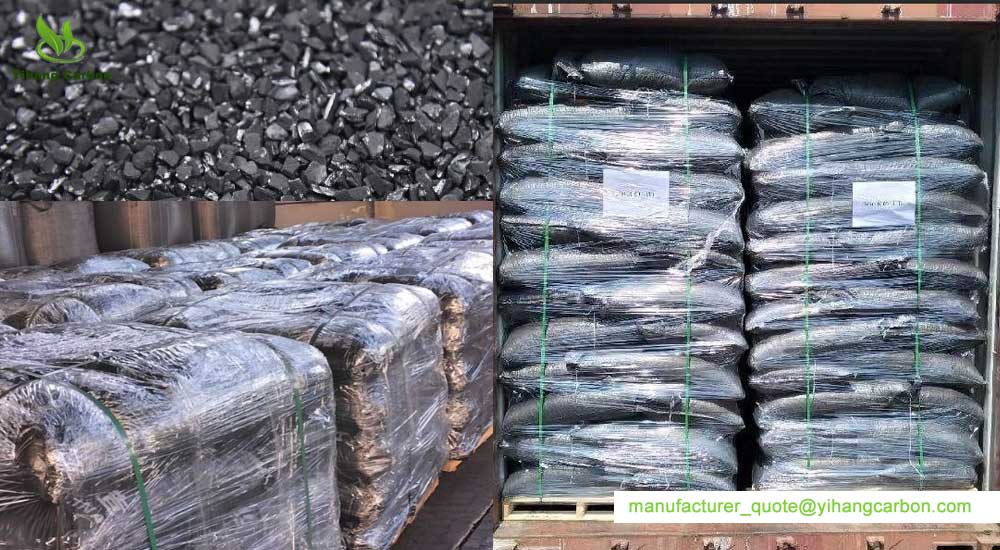
Yihang YHGold gold recovery carbon packed and loaded into a 40'HC export container — Export to Sudan's metallurgical market
As a well‑established Indian gold‑recovery activated‑carbon brand, SunCarb‑Gold offers consistent quality and proven track‑record across African mining sites. It is a fully qualified premium metallurgical‑grade carbon for gold extraction.
Against the benchmark of high‑quality imported carbon, YHGOLD GRADE 2000 achieves superior core physicochemical parameters: iodine number 1200 mg/g, CTC ≥ 60, ash < 3.0 % and moisture < 4.0 %. Additional strengths include uniform particle distribution, stable hardness, well‑developed pore structure and lower impurity levels. The product fully satisfies international CIP/CIL gold‑mine operational requirements. It outperforms conventional imported alternatives on key adsorption and purity metrics, and represents a reliable alternative with equivalent performance, better specifications and enhanced consistency for replacement or performance‑upgrade applications.
Share your operating mesh size, required adsorption parameters, and annual consumption. We provide official COA datasheets, customized quotations, and professional grade selection advice tailored to your CIP/CIL mining conditions within 1 hours.
 EN
EN