| Rank |
Manufacturer |
HQ / Base |
Core coal type |
GAC iodine (mg/g) |
Capacity |
Main markets |
| 1 |
Calgon Carbon |
Pennsylvania, USA |
Bituminous |
900–1050 |
~200,000 t/yr (all carbons) |
North America, Europe (municipal) |
| 2 |
Jacobi Carbons |
Sweden / India |
Bituminous |
900–1050 |
~70,000 t/yr (all carbons) |
Europe, Middle East, global distribution |
| 3 |
Yihang Carbon |
Ningxia, China |
Anthracite & bituminous |
800–1050 |
\[~20,000 t/yr] |
Africa, Middle East, Southeast Asia |
| 4 |
Cabot Norit |
Netherlands / USA |
Lignite & bituminous |
800–1000 |
~150,000 t/yr (all carbons) |
US/EU industrial, power, food |
| 5 |
Xingsen Carbon |
Ningxia, China |
Bituminous |
800–1000 |
\[~15,000 t/yr] |
Middle East, Africa, emerging Asia |
| 6 |
Huahui Carbon |
Ningxia, China |
Anthracite (extruded) |
800–950 |
\[~20,000 t/yr] |
Asia, Middle East (gas-phase) |
Note: capacities for the three international majors cover all carbon types (including PAC and extruded carbons); the three Chinese manufacturers are quoted on coal-based carbon only. The majors typically require a full container load (~13–20 t depending on bulk density), while Ningxia factories generally accept 1–10 t, and some will take smaller trial orders.
Need Coal-Based Granular Activated Carbon?
Get Factory?Direct Pricing — No Middlemen
30 years manufacturing. MOQ 1 ton. Free samples. Reply within 1 hours.
3. Manufacturer Profiles
No.1. Calgon Carbon (Kuraray) — The Global Municipal Benchmark
The oldest and most trusted name in the industry, acquired by Japan's Kuraray in 2018. Its Filtrasorb series of bituminous GAC is the most-referenced specification in municipal tender documents worldwide; countless PFAS removal and taste-and-odor projects in North America and Europe are written around Filtrasorb specs.
Strengths: unmatched brand trust; highly standardized grades; a reactivation network across North America and Europe offering full "virgin + reactivation" lifecycle service. Trade-offs: the highest prices in this list — typically 40%–80% above Chinese FOB levels for equivalent specs; limited flexibility on small or trial orders. Capacity: ~200,000 t/yr (all carbons) | Certifications: NSF/ANSI 61, AWWA B604, ISO 9001/14001 | Best for: well-funded US/EU municipal projects and spec-driven tenders
No.2. Jacobi Carbons (Osaka Gas) — The Distribution King
Headquartered in Sweden with production centered in India, and owned by Osaka Gas. Its AquaSorb bituminous GAC range covers the full 800–1050 iodine band. With warehousing and sales operations in more than 50 countries, Jacobi pairs low-cost-origin manufacturing with Western-grade service and documentation, and holds strong positions in European and Middle Eastern water treatment.
Strengths: extensive global logistics and after-sales network; excellent batch consistency and documentation. Trade-offs: priced in the Western tier; limited customization flexibility compared with factory-direct sourcing. Capacity: ~70,000 t/yr (all carbons) | Certifications: NSF/ANSI 61, EN 12915, ISO 9001, REACH | Best for: buyers wanting a brand-name bituminous GAC with multi-country delivery support
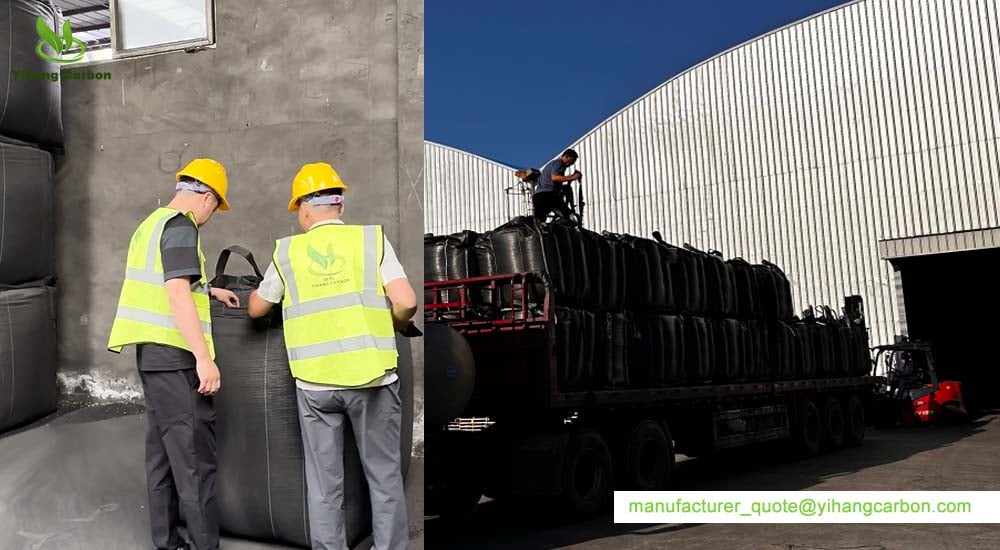
No.3. Yihang Carbon — A Leading Automated Manufacturer from China's Ningxia Belt
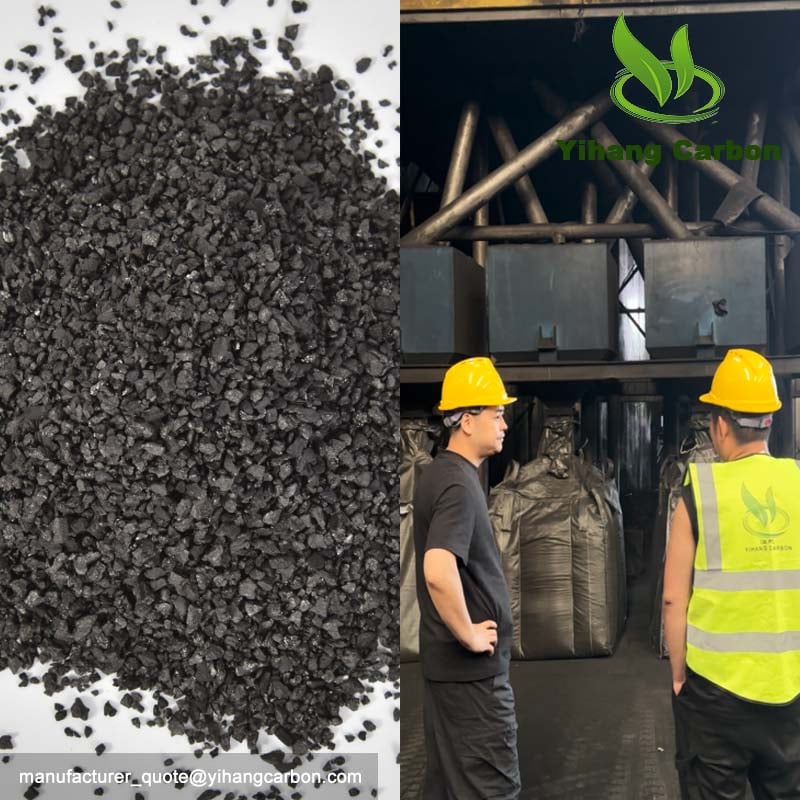
Based in Ningxia, China — the country's most concentrated coal-based carbon production region, sitting on the Taixi anthracite and Lingwu bituminous feedstock bases — Yihang Carbon ranks among China's leading coal-based activated carbon manufacturers. The plant operates automated Slep activation lines, with crushing, activation, screening, and packing all under automated process control, giving it a solid reputation for batch consistency within the region.
The product range is comprehensive: crushed GAC screened from 0.5–4 mm, extruded carbon customizable from 1.5–8 mm in diameter, iodine values spanning 800–1050 mg/g, plus custom grades such as acid-washed low-ash. On the export side, Yihang ships significant volumes to Africa, the Middle East, and Southeast Asia — markets where feedback consistently centers on "full spec range, stable quality, responsive after-sales." That profile fits water projects with tight budgets and tight timelines particularly well.
Strengths: automated lines and high batch consistency; broad spec coverage with customization flexibility; complete quality, service, and after-sales system. Trade-offs: brand awareness in Western Europe and North America is still building. Capacity: [~20,000 t/yr] | Certifications: ISO 9001, ISO 14001, SGS-audited [, drinking-water approval] | Best for: municipal and industrial water projects in Africa, the Middle East, and Southeast Asia
No.4. Cabot Norit — The Quiet Champion of PAC and Mercury Control
A Dutch carbon producer with a portfolio spanning lignite, bituminous, and coconut shell carbons. Its Norit and Darco powdered activated carbon (PAC) lines are global leaders, particularly in mercury capture at coal-fired power plants and decolorization for food and beverage. Its granular range is complete as well.
Strengths: deep expertise across both PAC and GAC; rich application references in mercury and decolorization; full certification for regulated industries (power, food). Trade-offs: lignite-based grades carry lower iodine; GAC is not its strongest line, and pricing runs high. Capacity: ~150,000 t/yr (all carbons) | Certifications: NSF/ANSI 61, EN 12915, ISO 9001, REACH | Best for: power-plant mercury control, food decolorization, certification-heavy US/EU industrial buyers
No.5. Xingsen Carbon — The Flexible, Fast-Response Regional Player
Also rooted in the Ningxia production belt, Xingsen focuses on bituminous GAC for the mid-range water treatment market. Its hallmarks are fast quotations, short lead times, and flexible handling of small orders and mixed-container shipments — a good match for traders and small-to-mid-size water plants.
Strengths: highly competitive pricing; low barriers for samples and trial orders; experienced export operations in emerging markets. Trade-offs: limited capacity for premium specs (acid-washed low-ash, high-iodine custom grades); a thinner international certification portfolio than top-tier factories. Capacity: [~15,000 t/yr] | Certifications: ISO 9001, SGS testing | Best for: cost-sensitive projects, small and mid-sized distributors, municipal works in developing markets
No.6. Huahui Carbon — The Taixi Anthracite Extruded-Carbon Specialist
A classic "deep single product" factory built around Ningxia's Taixi anthracite. Huahui's extruded carbon is positioned on high CTC (50–70) and strong gas-phase performance, with a solid reputation in desulfurization, denitrification, H₂S removal, and solvent recovery; its water-treatment extruded grades are also consistently available.
Strengths: direct sourcing of Taixi anthracite with outstanding gas-phase metrics (CTC, crush strength); a full extruded-size range (1.5–8 mm customizable). Trade-offs: a relatively narrow product line — fewer choices in crushed GAC and general water-treatment grades; MOQ on the high side (from 10 t). Capacity: [~20,000 t/yr] | Certifications: ISO 9001 | Best for: bulk gas-phase duty such as flue-gas desulfurization, VOCs control, and solvent recovery
Need Coal-Based Granular Activated Carbon?
Get Factory?Direct Pricing — No Middlemen
30 years manufacturing. MOQ 1 ton. Free samples. Reply within 1 hours.
4. How to Vet a Quality Supplier
A ranking is only a starting point. What decides success is the vetting process. We recommend five steps:
Step 1 — Verify it is a real factory. Request a live video tour or an on-site audit, focusing on whether the supplier owns its activation kilns (Slep or rotary) and how automated the lines are. Pure repackagers cannot guarantee batch consistency and often add a markup.
Step 2 — Lock the full spec sheet, not just iodine. For municipal and industrial water duty, confirm iodine (ASTM D4607), methylene blue, hardness (ASTM D3802), ash, apparent density, and particle-size distribution together. Make sure the COA corresponds to the exact grade — not a generic "factory certificate."
Step 3 — Verify certification scope. For potable-water projects, confirm that NSF/ANSI 61 (US) or EN 12915 (EU) covers the specific grade being purchased — not merely the facility. For projects with special regulatory requirements, check the relevant drinking-water approvals.
Step 4 — Test samples independently. Request 1–2 kg samples from 2–3 shortlisted suppliers and send them to SGS, Intertek, or a local accredited lab. Adsorption performance depends heavily on feed coal and activation craft — measured data beats any sales pitch.
Step 5 — Start with a trial order. Keep the first order in the 5–20 t range to evaluate spec stability, lead time, packaging (jumbo bags / small bags), and documentation accuracy — then scale up to an annual framework once performance is proven.
5. Frequently Asked Questions
Q1: Coal-based GAC or coconut shell GAC — which should I choose for water treatment? It depends on the duty and the budget. For organics, color, and chlorine removal in municipal/industrial water,
coal-based GAC offers clearly better value. For ultra-pure water — semiconductor or electronics-grade — where extractables and micropore capacity are critical, choose coconut. In short: high-volume routine purification favors coal; extreme purity favors coconut.
Q2: What iodine value counts as qualified for coal-based GAC? For routine water treatment, aim for ≥900 mg/g; for higher-grade potable water, 950 mg/g and above. Remember, iodine is only an entry-level metric — always check hardness, ash, and methylene blue alongside it. Be wary of products that advertise a high iodine number while glossing over everything else.
Q3: What does coal-based GAC cost in 2026? Indicative FOB China levels: standard water-treatment bituminous GAC around USD 700–1,100/ton; acid-washed or premium high-iodine grades USD 1,100–1,600/ton; anthracite extruded carbon USD 900–1,400/ton. Western producers typically charge 40%–80% more for equivalent specs. Add ocean freight (roughly USD 80–200/ton to the US or EU), duties, and inland logistics for a true landed cost.
Q4: What is the typical MOQ? The international majors usually require a full container load (~13–20 t). Ningxia factories generally accept 1–10 t, and some take trial orders below that. Distributors can break bulk down to jumbo bags or even small bags, at a higher unit price. Kilogram-scale lab samples are typically free or inexpensive.
Q5: How do I judge whether a quotation is trustworthy? Treat any quote deviating more than 20% from market averages with suspicion. Too low can mean under-activation, blended recycled carbon, or a cheaper coal type substituted for the specified one; too high usually signals layered distributor markups. The most reliable filter remains "sample testing + third-party inspection."
The Bottom Line
There is no single "best" coal-based GAC manufacturer — only the one best suited to your project. The Western majors win on brand trust and local service infrastructure; China's leading regional factories win on automated production, full spec coverage, and overall cost. Shortlist two or three suppliers, and let sample test data — not brand names — make the final call.
 EN
EN