Nov 09,2026
Chlorine is widely used in municipal water treatment and industrial water disinfection because of its ability to control microorganisms and maintain water quality throughout distribution systems. However, residual chlorine is not always desirable in downstream applications. Excess chlorine may affect product quality, alter the taste and odor of water, and interfere with certain industrial processes.
Activated carbon has become an important filtration material for removing residual chlorine from water. Its porous structure and surface chemical properties make it suitable for dechlorination, as well as the reduction of organic substances that contribute to unwanted taste, odor, and color.
For water treatment operators, selecting the right activated carbon involves more than simply checking its iodine value. Raw material, particle size, mechanical strength, water quality, and filter operating conditions all influence the final treatment performance.
This article explains how activated carbon works in dechlorination systems, where it is used, and what factors should be considered when selecting granular activated carbon for water purification.
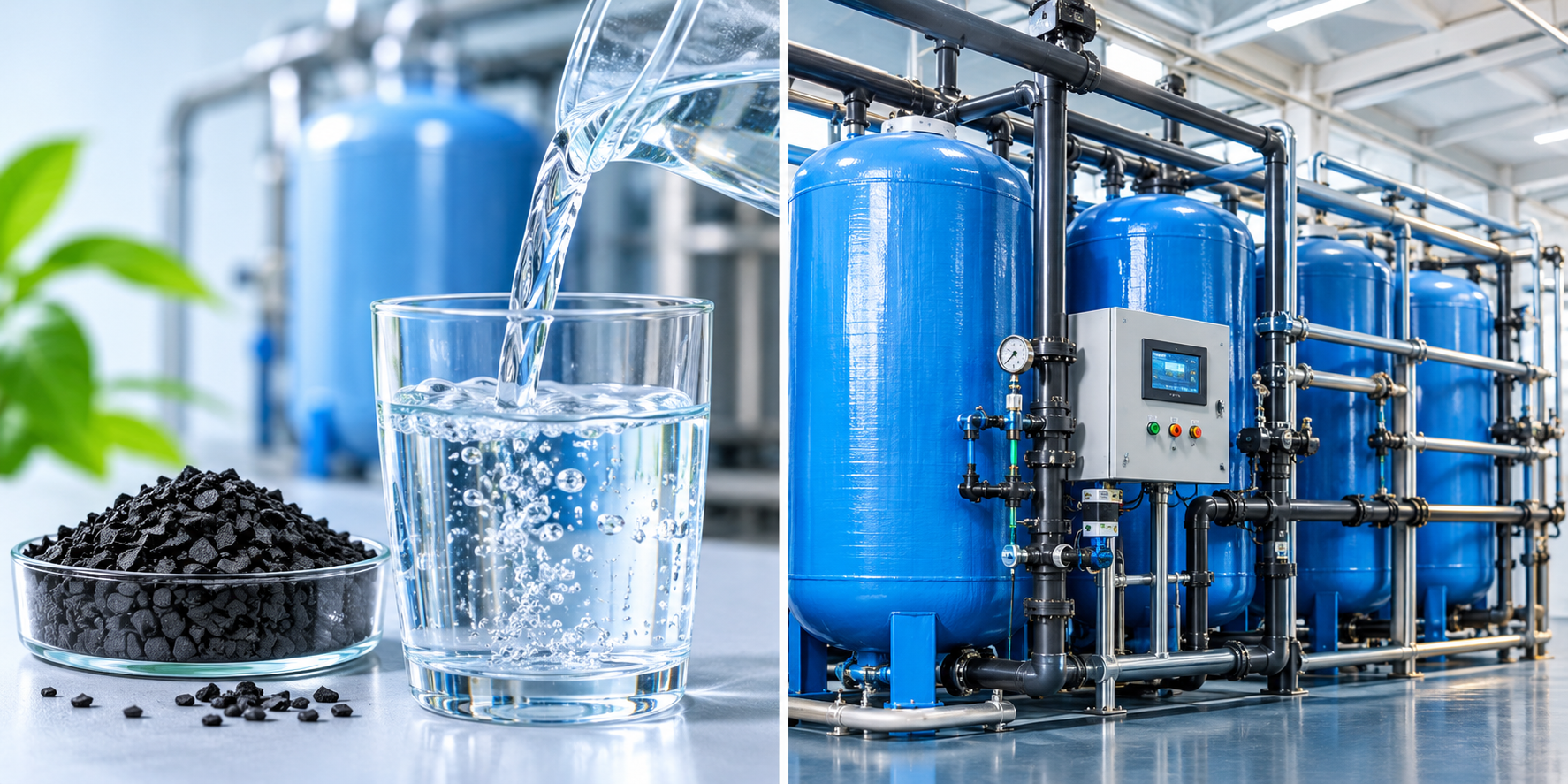
Chlorination is an established disinfection method used in municipal water supplies, swimming pools, industrial water systems, and many other applications. It helps control microbial contamination and maintain a disinfectant residual in treated water.
Nevertheless, chlorine remaining in water may create problems for subsequent treatment processes.
For example, in reverse osmosis systems, residual chlorine can damage chlorine-sensitive membrane materials if appropriate pretreatment is not provided. In food and beverage manufacturing, excessive residual chlorine may affect product taste, odor, and certain processing ingredients.
In addition, some industrial processes require water with a controlled chlorine concentration to protect sensitive equipment and maintain product consistency.
Common situations requiring dechlorination include:
Drinking Water Purification: Reducing residual chlorine to improve the taste and odor of treated water.
Reverse Osmosis Pretreatment: Protecting chlorine-sensitive RO membranes from oxidative damage.
Food and Beverage Manufacturing: Preparing process water for beverage production, ingredient preparation, and other food-related operations.
Aquaculture: Removing residual disinfectants that may be harmful to aquatic organisms.
Industrial Process Water: Controlling chlorine levels before water enters sensitive production processes.
Pharmaceutical and Laboratory Water Systems: Supporting downstream purification processes where residual oxidants must be controlled.
The required chlorine level after treatment depends on the intended application and applicable water quality standards. Therefore, the dechlorination system should be designed around the actual water quality requirements rather than a general removal target.
Activated carbon removes free chlorine primarily through surface-mediated chemical reactions, commonly described as catalytic reduction.
Unlike many organic contaminants that are retained through physical adsorption, free chlorine reacts with the activated carbon surface and is converted into chloride ions.
The reaction involves interactions between chlorine species in water and reactive sites on the carbon surface. The characteristics of these surface sites, together with the available contact area, influence the reaction rate.
Several factors determine the effectiveness of this process:
Carbon Surface Properties
The surface chemistry of activated carbon plays an important role in dechlorination. Surface functional groups and the condition of the carbon surface can influence the reaction between activated carbon and chlorine.
Particle Size
Smaller carbon particles generally provide a larger external surface area per unit volume and shorter diffusion distances. This can improve reaction rates, although finer particles may also increase pressure drop and create additional requirements for filtration and backwashing.
Water Chemistry
Water pH, temperature, initial chlorine concentration, and the presence of other dissolved substances may influence treatment performance.
Contact Time
Sufficient contact between water and activated carbon is essential. If water passes through the filter too quickly, the chlorine concentration at the outlet may remain above the required level.
It is also important to distinguish free chlorine from chloramine. Chloramine is generally more difficult and slower to remove using conventional activated carbon. Systems treating chloraminated water may require longer contact times or specially developed catalytic activated carbon.
Activated carbon is used in a wide range of water purification systems. Its ability to reduce residual chlorine while also treating certain organic contaminants makes it particularly useful in multi-stage filtration processes.
Municipal Drinking Water Treatment
Municipal water treatment facilities commonly use granular activated carbon to improve water quality after conventional treatment processes.
In addition to chlorine reduction, GAC can help control organic substances responsible for undesirable taste and odor. Depending on the treatment configuration, activated carbon may be installed in dedicated contactors or integrated into a larger filtration system.
Reverse Osmosis Water Treatment
Chlorine removal is an important pretreatment step in many RO water purification systems.
Polyamide reverse osmosis membranes are sensitive to oxidation by free chlorine. If chlorinated water enters the membrane system without adequate dechlorination, membrane performance and service life may be adversely affected.
Granular activated carbon filters are therefore frequently installed before RO membranes to reduce residual chlorine.
For critical RO applications, outlet chlorine monitoring is recommended to verify that the carbon filter is operating effectively.
Food and Beverage Processing
Water quality directly influences the quality and consistency of food and beverage products.
Activated carbon filtration can be used to reduce residual chlorine, improve taste and odor, and remove certain organic impurities from process water.
Typical applications include:
Bottled drinking water production.
Soft drink and beverage manufacturing.
Brewing and food ingredient preparation.
Dairy processing water treatment.
General food production water purification.
For these applications, carbon selection should consider not only dechlorination performance but also ash content, extractable substances, mechanical stability, and relevant food-contact requirements.
Aquaculture and Fish Farming
Residual chlorine can be harmful to fish and other aquatic organisms, even at relatively low concentrations.
Activated carbon filtration is therefore used in certain aquaculture systems to reduce disinfectant residues before water enters fish tanks or recirculating systems.
Stable water quality is especially important in intensive aquaculture, where water is continuously circulated and reused.
Industrial Process Water
Various industrial processes require controlled water quality to avoid unwanted chemical reactions, protect equipment, and maintain production stability.
Activated carbon dechlorination systems may be incorporated into pretreatment lines for electronics manufacturing, chemical production, cooling water preparation, and other industrial applications.
The appropriate carbon grade depends on the water composition and the requirements of the downstream process.
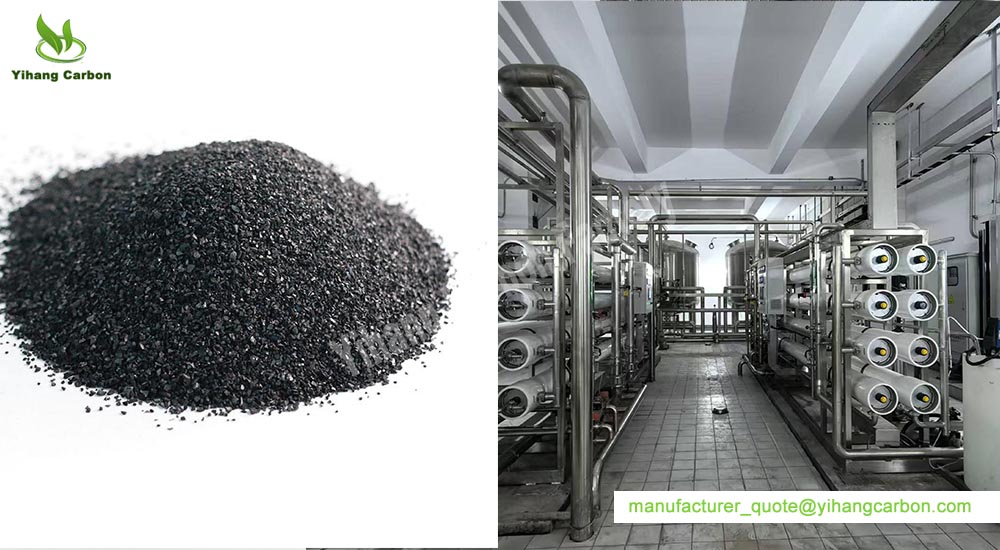
Choosing an appropriate activated carbon grade is an important step in achieving reliable chlorine removal.
Two commonly used materials are coconut shell activated carbon and coal-based activated carbon. Both can be used in water treatment, but their physical and pore characteristics differ.
Coconut Shell Activated Carbon
Coconut shell activated carbon is widely used in drinking water purification and other applications requiring good mechanical strength.
Its main characteristics include:
These properties make coconut shell GAC a suitable option for water filtration systems where low fines generation and stable media performance are important.
Coal-Based Activated Carbon
Coal-based granular activated carbon is another established choice for industrial water treatment.
Depending on the coal source and activation process, it can offer a relatively broad pore-size distribution and a range of mechanical and adsorption properties.
Potential advantages include:
Coal-based GAC is frequently considered for municipal and industrial water purification projects where filtration capacity and operating economics are important.
Coconut Shell GAC vs. Coal-Based GAC
|
Parameter |
Coconut Shell GAC |
Coal-Based GAC |
|
Raw Material |
Coconut shells |
Selected coal |
|
Pore Structure |
Generally micropore-dominant |
Generally broader pore distribution |
|
Hardness |
Typically high |
Depends on grade |
|
Ash Content |
Often relatively low |
Depends on grade |
|
Mechanical Stability |
Generally very good |
Varies by manufacturing process |
|
Typical Applications |
Drinking water, food and beverage filtration |
Municipal and industrial water treatment |
|
Selection Consideration |
Low fines and mechanical durability |
Grade flexibility and project economics |
There is no universal rule that one raw material always performs better than the other in chlorine removal. Actual performance depends on surface characteristics, particle size, water chemistry, and operating conditions.
Even high-quality activated carbon cannot achieve satisfactory results if the filtration system is improperly designed.
Several operating parameters should be evaluated before selecting a carbon grade.
Empty Bed Contact Time (EBCT)
Empty Bed Contact Time is one of the most important parameters in granular activated carbon filter design.
It represents the theoretical time water remains in contact with the empty volume of the carbon bed.
The calculation is:
EBCT (minutes) = Carbon Bed Volume (L) ÷ Water Flow Rate (L/min)
For example, a filter containing 500 liters of activated carbon operating at a flow rate of 100 liters per minute has an EBCT of 5 minutes.
The required contact time depends on the target contaminant, chlorine concentration, carbon properties, and outlet water requirements.
Chloramine treatment generally requires more demanding operating conditions than free chlorine removal. Pilot testing is advisable when the water contains significant chloramine concentrations.
Particle Size Distribution
The particle size of activated carbon affects reaction kinetics, pressure drop, and backwashing behavior.
Common GAC grades used in water treatment include:
4×8 mesh: Suitable for selected larger-particle filtration systems.
8×30 mesh: A commonly used grade for granular water filtration.
12×40 mesh: A finer grade for systems requiring smaller particles.
The final selection should match the filter design, water flow rate, and hydraulic requirements.
Mechanical Strength and Abrasion Resistance
During operation, activated carbon may be exposed to repeated backwashing, water movement, and mechanical handling.
Carbon with insufficient mechanical strength may generate excessive fines, resulting in increased pressure drop and the potential for downstream particle carryover.
Hardness, abrasion resistance, and particle size distribution should therefore be considered when evaluating GAC for continuous water treatment.
Pressure Drop and Backwashing
The hydraulic resistance of a carbon bed depends on particle size, bed depth, flow velocity, and water viscosity.
Finer carbon particles generally create greater resistance to water flow. Backwashing is commonly used to remove accumulated suspended solids and redistribute the carbon bed.
The backwashing procedure should be designed according to the carbon particle size, density, and filter configuration to minimize media loss.
When purchasing granular activated carbon for dechlorination, buyers should evaluate a complete set of technical indicators rather than relying on iodine value alone.
The following table provides general specification considerations for water treatment GAC. These are indicative purchasing parameters, not guaranteed specifications for every grade.
|
Technical Parameter |
Typical Consideration |
|
Raw Material |
Coconut Shell / Coal |
|
Particle Size |
8×30 Mesh / 12×40 Mesh |
|
Iodine Number |
Grade-dependent; commonly 800–1,100 mg/g |
|
Hardness |
Grade-dependent |
|
Moisture |
Commonly controlled at ≤5% |
|
Ash Content |
Depends on raw material and washing process |
|
Apparent Density |
Depends on carbon grade |
|
pH Value |
Depends on activation and washing conditions |
|
Abrasion Resistance |
Evaluated according to application requirements |
Iodine number is a useful indicator of micropore adsorption capacity, but it should not be treated as a direct measurement of chlorine removal efficiency.
For dechlorination projects, actual chlorine reduction testing under representative operating conditions provides more meaningful information about the suitability of a particular carbon grade.
For distributors, engineering companies, and industrial buyers, selecting a reliable activated carbon supplier is as important as choosing the right product.
Before placing an order, buyers should consider the following aspects:
Consistent Product Quality
The supplier should be able to provide technical specifications and batch-related quality documentation. Consistency in particle size, hardness, moisture, and ash content is important for long-term filter operation.
Product Customization
Different filtration systems require different particle sizes and physical characteristics. A supplier capable of offering multiple grades of coconut shell and coal-based GAC can provide greater flexibility for project requirements.
Technical Documentation
Typical purchasing documents include:
Technical Data Sheet (TDS).
Certificate of Analysis (COA).
Safety Data Sheet (SDS/MSDS).
Relevant quality management certificates.
Applicable food-contact or drinking-water compliance documentation, where required.
Export and Packaging Capability
For international projects, packaging options, container loading arrangements, production lead times, and export documentation should also be considered.
A qualified supplier should be able to discuss these details clearly before order confirmation.
Yes. Granular activated carbon can effectively reduce free chlorine through surface-mediated chemical reactions. The actual removal efficiency depends on carbon properties, contact time, influent water quality, and filter operating conditions.
Both types can be used for dechlorination. Coconut shell GAC is often selected where high hardness and low fines generation are important. Coal-based GAC offers different pore structures and product grades suitable for various industrial filtration systems.
Yes, activated carbon can remove chloramine, but the process is generally slower than free chlorine reduction. Longer contact time or specially designed catalytic activated carbon may be necessary to achieve the required outlet concentration.
8×30 mesh is a commonly considered particle size for granular water filtration. However, 4×8 mesh and 12×40 mesh may also be suitable depending on the filter design and hydraulic requirements.
Not necessarily. Iodine value mainly indicates the adsorption capacity associated with smaller pores. Chlorine removal also depends on the reactive properties of the carbon surface, particle size, and operating conditions.
There is no fixed replacement interval applicable to every dechlorination system. Service life depends on the carbon grade, water contaminants, mechanical degradation, filtration conditions, and operating schedule. Regular monitoring of outlet chlorine concentration and filter performance is recommended.
Yes. GAC filtration is commonly used as a pretreatment method to reduce free chlorine before chlorine-sensitive RO membranes. The outlet chlorine concentration should be monitored to ensure adequate membrane protection.
YIHANG CARBON provides a range of activated carbon products for water purification, industrial filtration, and other treatment applications.
Our product portfolio includes coconut shell granular activated carbon, coal-based granular activated carbon, powdered activated carbon, and other specialty carbon materials.
We understand that different water treatment projects have different technical requirements. Therefore, product selection should be based on the actual operating conditions rather than a single general specification.
Whether you are sourcing activated carbon for municipal water treatment, RO pretreatment, drinking water purification, or industrial dechlorination systems, our team can assist with product specifications, technical documentation, packaging arrangements, and export supply.
YIHANG CARBON – Reliable Activated Carbon Solutions for Global Water Treatment Applications.
Contact YIHANG CARBON and share your application, required particle size, water flow rate, and target chlorine concentration. Our team will help you evaluate a suitable activated carbon option for your project.
 EN