Request a Quote

Please fill out the consultation form below. We will contact you within 1 hour and provide professional services.
Email
Name
Mobile/WhatsApp
Message
0/1000

Coal-Based Granular Activated Carbon (GAC) for Water Treatment | High Iodine Value | Low Ash

Product Overview

This coal-based granular activated carbon is steam-activated from premium anthracite coal, featuring a balanced micropore and mesopore structure for both liquid-phase and gas-phase adsorption.
Key facts:
  • Iodine number up to 1100 mg/g — among the highest in coal-based GAC
  • Ash content as low as 8% (≤3% after acid washing)
  • Hardness ≥95% — minimal breakage and attrition loss
  • Mesh sizes: 8×30, 12×40, 30×60 in stock; 50×80 mesh and other custom sizes available
  • Applications: municipal drinking water, industrial wastewater, pool water, groundwater remediation, air purification
It is one of the most cost-effective granular activated carbons for large-scale fixed-bed filtration systems.

Technical Specifications

Parameter Specification Notes
Raw Material Premium anthracite coal Bituminous blend optional
Iodine Number 600 – 1100 mg/g Up to 1100 available
Surface Area 900 – 1200 m²/g BET method
Ash Content ≤ 8% – 12% ≤3% after acid washing
Hardness ≥ 95% Ball-milling method
Moisture ≤ 5%
Bulk Density 0.45 – 0.55 g/cm³
pH 7 – 10 6–8 for acid-washed grade
Particle Size 4×8 / 8×30 / 12×40 / 30×60 mesh ( 2.4-4.75mm / 0.6-2.4mm / 0.42-1.7mm / 0.3-0.85mm) Custom 50×80 mesh available
Activation High-temperature steam Regenerable 3–5 cycles

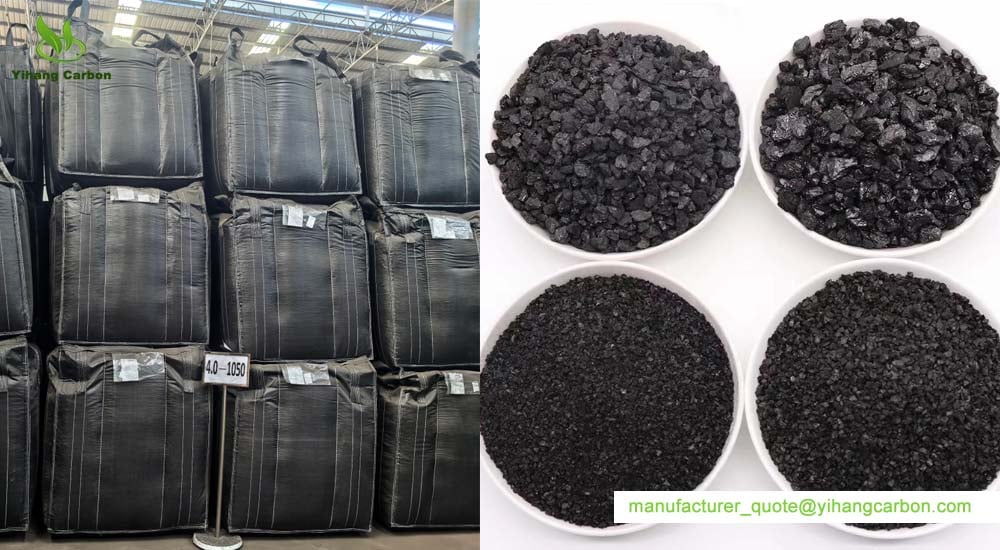
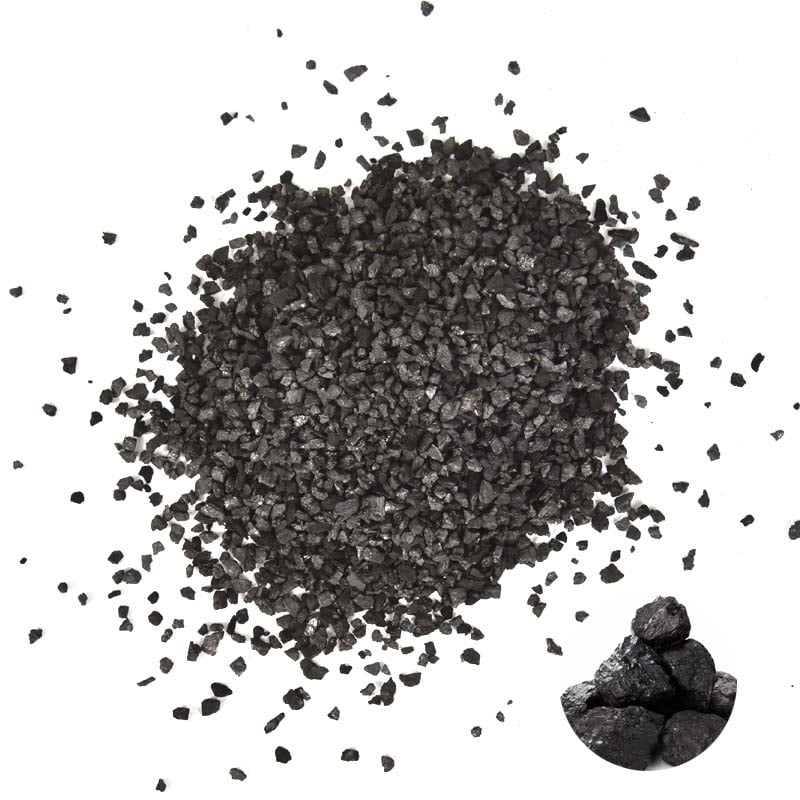
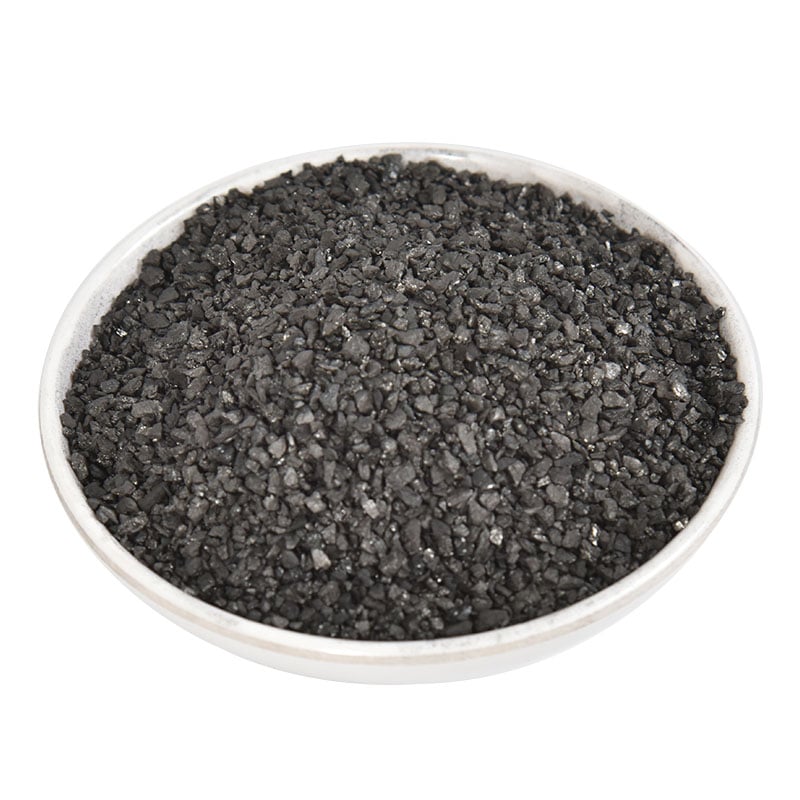
Coal‑based Granular Activated Carbon 830 mesh VS 1240 mesh.jpg

Different-sized Coal-Based Granular Activated Carbon (GAC)

Key Advantages

High iodine number — stronger adsorption
With an iodine number up to 1100 mg/g and surface area up to 1200 m²/g, this GAC delivers significantly higher adsorption capacity for chlorine, organics, odors, and trace contaminants than standard 600–800 iodine products — meaning longer bed life and lower cost per ton of water treated.
Low ash — cleaner effluent
Ash content controlled at 8% or below (≤12% standard, ≤3% acid-washed), preventing carbon fines from raising effluent turbidity — critical for drinking water and high-purity water systems.
High hardness — lower operational loss
Hardness ≥95% resists abrasion and breakage during backwashing and bed loading, keeping pressure drop stable and reducing carbon makeup consumption.
Full mesh range — in stock
Standard 8×30, 12×40, and 30×60 mesh available from stock. Custom sizes such as 50×80 mesh can be produced to match your flow rate, contact time, and pressure-drop requirements.
Balanced pore structure — broad applicability
Balanced micropores (small molecules) and mesopores (large organic molecules) enable effective removal of natural organic matter (NOM), pesticide residues, and odor compounds.
Factory-direct consistency
In-house production from raw material selection through activation, sieving, and batch testing. Every batch ships with a COA, with tight, repeatable tolerances across large export orders.
Regenerable — lower lifetime cost
Thermal regeneration restores 85–95% of original capacity for 3–5 cycles, reducing long-term operating cost for large treatment plants.

Applications & Problems Solved

Application Problem Solved
Municipal drinking water treatment Removes residual chlorine, odor compounds, and organic micropollutants; improves taste
Industrial wastewater treatment Reduces COD, color, phenols, and refractory organics to meet discharge limits
Pure / ultrapure water pretreatment (RO) Dechlorination protects RO membranes; organics removal prevents membrane fouling
Swimming pool water circulation Removes chloramines, urea by-products, and odors
Groundwater remediation Adsorbs petroleum hydrocarbons and VOCs
Power plant / chemical plant circulating water Controls organic buildup and reduces biocide consumption
Air & gas purification Removes H₂S, VOCs, and odors (impregnated grades available)

Specifications & Customization

  • Packaging: 25 kg PP woven bags; 500 kg jumbo bags (FIBC)
  • Processing options: Acid washing (lower ash, neutral pH), water washing, impregnation (KOH, iodine, sulfur)
  • Trial order: 1-ton trial orders accepted
  • Free samples: Free samples provided for testing before purchase; shipped within 3–5 days
  • Customizable: Particle size, iodine value, ash limit, packaging, and branding

Certifications & Documentatio

  • SGS / ISO 9001 / NSF-related certifications and third-party testing support
  • COA (Certificate of Analysis) issued before every shipment
  • Raw material test reports available
  • Factory business license and export credentials provided
  • Sea freight transport appraisal report and full export documentation

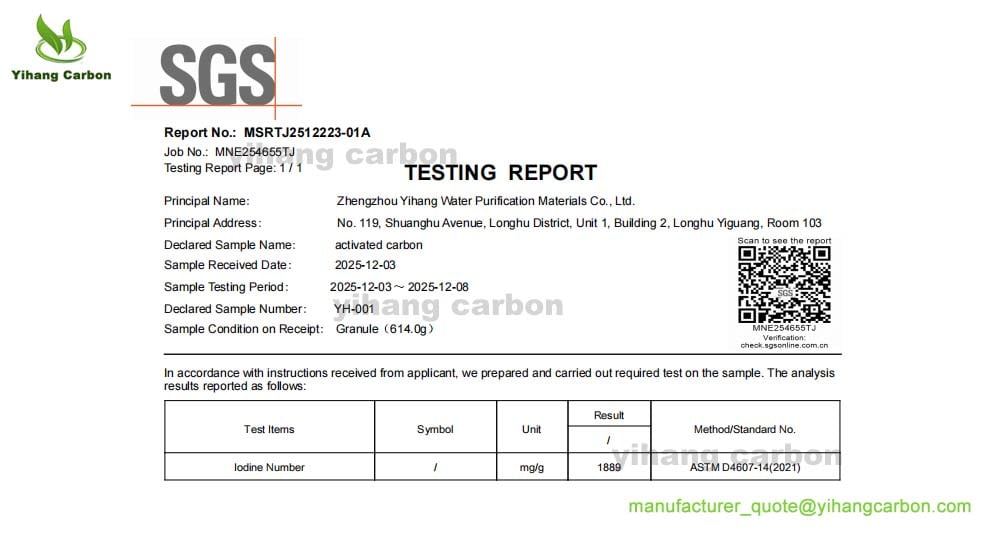
SGS Activated Carbon Test Report.jpg

SGS for Activated Carbon Test Report from Yihang carbon

Packaging, Logistics & Delivery

  • OEM/custom branded packaging available (free design service)
  • Standard export pallets with full stretch-film moisture protection
  • Lead time:
    • 5–10 tons: ships within 3 days
    • 10–20 tons: ships within 5–7 days
    • 30–50+ tons: ships within 10–15 days
    • Other quantities confirmed in advance
  • Sea, rail, and air freight supported; complete export documentation handled by our logistics team

Frequently Asked Questions

Q1: Should I choose coal-based or coconut shell GAC?
Coal-based GAC costs 30–50% less and has a stronger mesopore structure, making it ideal for large-scale industrial water treatment. Coconut shell GAC offers higher hardness (≥98%) and lower ash (<3%) for drinking water and high-value applications. For budget-sensitive, high-volume projects, coal-based is the recommended choice.
Q2: How long does a 1100 iodine GAC bed last?
Typically 1–3 years for drinking water and 6–12 months for industrial wastewater, depending on influent contaminant load. Monitor effluent quality and replace before breakthrough.
Q3: Which mesh size should I choose?
8×30 mesh is the most versatile for general water treatment. Coarser sizes suit high-flow, low-pressure-drop filtration; 12×40 or 30×60 mesh suits applications requiring high contact area and fine filtration.

Q4: Do I need pre‑treat new GAC before filling?

A: For water‑phase applications, soak and rinse with clean water to wash off surface fine powder, preventing blockage of filter tank and downstream pipelines. For gas‑phase systems, GAC can be loaded directly without pre‑washing.

Q5: How to get samples? What is MOQ?

A: Free samples are available; freight cost shall be borne by buyer. Minimum order quantity is 1 ton for trial runs for process validation.
Q6: What is the MOQ?
1 ton for trial orders. Volume pricing available for large orders.
Q7: Can the carbon be acid-washed or impregnated?
Yes. Acid washing reduces ash to below 3% and adjusts pH to neutral. Impregnation with KOH, iodine, or sulfur enhances targeted removal of gases such as H₂S and mercury vapor.
Q8: Can spent GAC be regenerated?
Yes. Thermal regeneration at 800–900°C restores 85–95% of adsorption capacity, typically for 3–5 cycles. For small systems, direct replacement is often more economical.
Q9: What payment terms do you accept?
T/T (30% deposit, balance against B/L copy) and L/C for bulk orders; T/T and PayPal for sample orders.

Request a Quote

Please fill out the consultation form below. We will contact you within 1 hour and provide professional services.
Email
Name
Mobile/WhatsApp
Message
0/1000
WeChat WeChat
WeChat
Phone Phone Email Email WhatApp WhatApp TopTop