Sep 21,2026
In CIP/CIL gold extraction, the grade of coconut shell gold recovery carbon decides both your gold recovery rate and your running cost. The Jacobi GoldSorb line is one of the most widely specified gold carbon product families on the international market, with GoldSorb™ 5500 sitting at the CTC 55 mid tier. YHGOLD Grade 1903, developed by Yihang carbon, is a coconut shell gold recovery carbon engineered precisely to this tier, supplied with a batch COA test report on every shipment. Based on both parties' published documents, this guide compares the two carbon products parameter by parameter. The core conclusion: YHGOLD Grade 1903 is a grade-for-grade, drop-in replacement for Jacobi GoldSorb 5500 — same coconut shell feedstock, same steam activation, same 6×12 mesh, same CTC 55 coconut shell gold recovery carbon — so it loads into the same circuit with no changes, while delivering a fully quantified ASTM-method COA for direct procurement verification.
Within the Jacobi GoldSorb gold carbon ladder, GoldSorb 5500 corresponds to the CTC 55 mid tier, between GoldSorb 4500 (CTC 45) and GoldSorb 6000 (CTC 60) — one of the most widely specified coconut shell gold recovery carbon grades used by mines worldwide. YHGOLD Grade 1903 from Yihang carbon is designed precisely to this tier as a same-grade replacement:
| Comparison | Jacobi GoldSorb 5500 | YHGOLD Grade 1903 (Yihang carbon) |
|---|---|---|
| Grade / Activity | CTC 55 | CTC ≥55% (COA-tested) |
| Replacement role | Benchmark product | Direct drop-in replacement |
| Feedstock & process | Coconut shell / steam activation | Coconut shell / steam activation |
| Target circuit | CIP / CIL / CIC | CIP / CIL |
Both grades sit at the same CTC 55 activity tier with the same coconut shell feedstock system — switching requires no redesign of the adsorption circuit and no change to contact time. That is what "same-tier replacement" really means, and the compatibility question that matters most when comparing coconut shell gold recovery carbons.
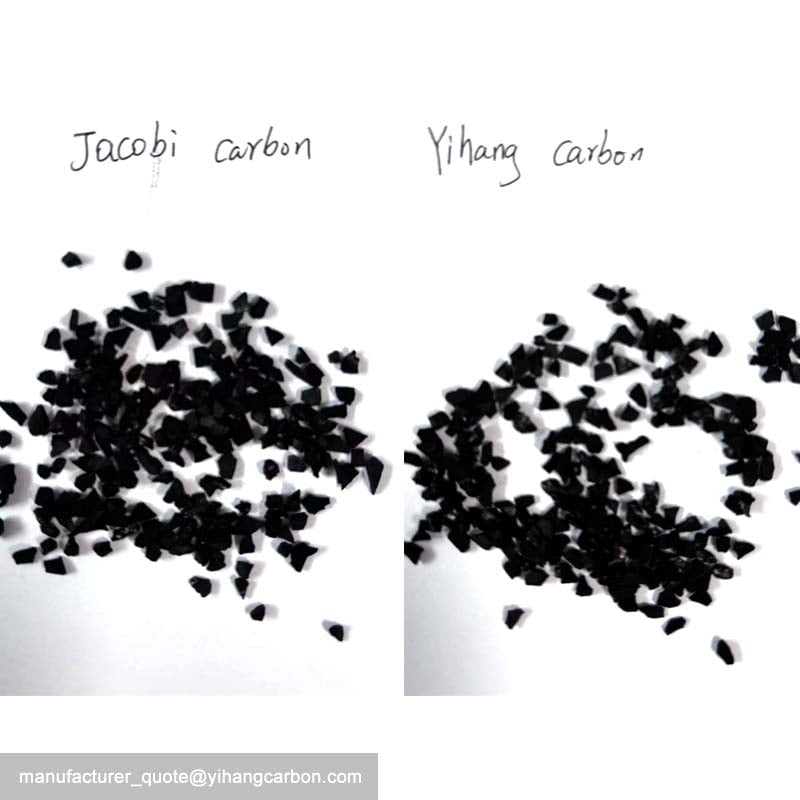
pic:Jacobi GoldSorb 5500 vs YHGOLD Grade 1903 Activated Carbon
The comparison below is strictly based on both parties' published documents: Jacobi GoldSorb figures come from its official technical datasheet (TDS); YHGOLD Grade 1903 figures come from Yihang carbon's 55CTC COA metallurgical carbon test report (2025-12-22). Wherever test methods or data basis differ, it is stated plainly.
| Parameter | YHGOLD Grade 1903 (COA-tested) | Jacobi GoldSorb 5500 (TDS) | Notes |
|---|---|---|---|
| Raw material | Coconut shell | Coconut shell | Same feedstock category |
| Activation | Steam activation | Steam activation | Same process route |
| Application | CIP / CIL gold recovery | CIP / CIL / CIC gold recovery, etc. | Same target use |
| CTC activity | ≥55% (ASTM D3467) | Grade name implies CTC 55; no value stated in TDS | Same tier |
| Iodine number | ≥1100 mg/g (ASTM D4607) | 1000mg/g | Micropore development; YHGOLD gives a firm floor |
| Ash content | ≤3% (ASTM D2866) | max4% | Lower = more effective surface for gold loading |
| Moisture | ≤4% (ASTM D2867) | max5% | Within industry norm |
| Apparent density (dry) | 480–520 g/cc (ASTM D2854) | 450-650kg/m3 | Useful for charge-volume calculations |
| Hardness | ≥99.5% (Ball Pan, ASTM D3802) | min98% | Directly comparable under the same method |
| Loss on attrition | ≤2% (ASTM D4058) | max2% | Low attrition = less carbon loss in circuit |
| Platelet content | ≤6% (AARL) | 7% | Low platelets = better screening behaviour |
| Extractable pH | 9–11 (ASTM D3838) | 8-11 | — |
| Mesh size | 6×12 / 8×16 / 4×8 USS | 6×12 / 8×16 / 4×8 available | Same 6×12 option — drop-in compatible |
| Particle size distribution | +6 ≤4%; 6×7 ≥20%; 7×8, 8×10 T&R; 10×12 ≤8%; -12 ≤2% (ASTM D2862) | Not stated in TDS | YHGOLD offers full screening control |
Honest note on data basis: the most visible structural difference in this table is that the Jacobi GoldSorb TDS leads with qualitative claims and design parameters, and does not publish quantified CTC, iodine, ash or other test values; YHGOLD Grade 1903's COA gives a firm, ASTM-method figure for every parameter. This does not mean the Jacobi product underperforms — it means the two documents differ in how much is quantified. For procurement flows that need written, batch-level verification, COA-style data is more direct and auditable.
The adsorption activity of coconut shell gold recovery carbon is judged mainly by two metrics: CTC value (carbon tetrachloride activity) and iodine number.
Coconut shell gold recovery carbon inside a CIL tank faces constant mechanical agitation. Low hardness means more breakage, more fines, and more gold escaping with the tailings; high attrition means higher carbon make-up rates and a direct hit on cost per ounce recovered.
Test-method note: Ball Pan hardness (ASTM D3802, tumbling/abrasion principle) is not directly comparable with compression-based methods (e.g. GB/T strength). When both suppliers report under the same method, the numbers can be compared head-to-head. This is precisely why Yihang carbon's YHGOLD Grade 1903 reports everything to ASTM international standards — it sits on the same measurement basis as international brands that also test to ASTM.
Whether a coconut shell gold recovery carbon is truly "drop-in" starts with mesh compatibility:
Jacobi GoldSorb is supplied by Jacobi Carbons (part of Osaka Gas Chemicals), a global premium brand — its pricing reflects brand position, global distribution, and supporting services (circuit audits, carbon management training, recovery circuit optimization), which are genuinely valuable to many mines.
Yihang carbon's YHGOLD Grade 1903 is positioned differently: same-tier performance + transparent data + factory-direct cost — together, these three make up the full case for "drop-in replacement":
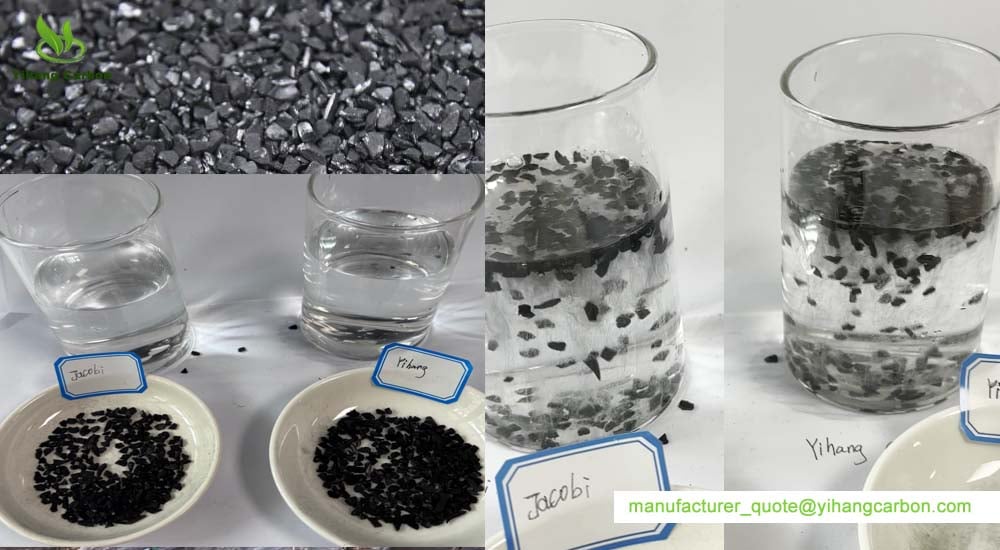
Jacobi GoldSorb 5500 vs YHGOLD Grade 1903 Activated Carbon-Bubble Experiment
| Decision factor | Stay with Jacobi GoldSorb 5500 | Switch to YHGOLD Grade 1903 (Yihang carbon) |
|---|---|---|
| CTC activity tier | CTC 55 | Same tier (≥55% COA-tested) |
| Written test data | Qualitative TDS claims | Fully quantified batch COA |
| Procurement verification | Specs agreed per contract | Verifiable on shipment, batch-traceable |
| Mesh compatibility | 6×12 / 8×16 / 4×8 | Same 6×12 / 8×16 / 4×8 — direct drop-in |
| Support services | Circuit audits / training | Factory-direct, on-request support |
| Price position | International brand premium | Same-tier performance, more competitive |
Consider YHGOLD Grade 1903 if: you currently run Jacobi GoldSorb 5500 (or any other CTC 55 coconut shell gold recovery carbon) and want to cut your carbon budget without changing your circuit or risking gold recovery, and your procurement needs a batch COA as the acceptance record.
Stick with Jacobi if: your tender specifically requires the Jacobi brand, or you need its carbon management training and circuit optimization services and the premium is within budget.
The definitive way to settle any replacement decision is a side-by-side loading test on your own pulp: request matched samples from both suppliers and run them under identical conditions — that is the only authoritative answer to whether a coconut shell gold recovery carbon is a true same-tier drop-in in your circuit.
30 years manufacturing. MOQ 1 ton. Free samples. Reply within 1 hours.
Q: Can YHGOLD Grade 1903 replace Jacobi GoldSorb 5500?
Yes. YHGOLD Grade 1903 is a CTC 55 coconut shell gold recovery carbon from Yihang carbon, same-tier as Jacobi GoldSorb 5500, steam-activated at the same 6×12 mesh, and can be loaded directly into an existing CIP/CIL circuit (a drop-in replacement) with no process changes. A side-by-side loading test on your own pulp is recommended as final confirmation.
Q: What actually differs between YHGOLD Grade 1903 and GoldSorb 5500?
The activity tier is the same (CTC 55) and both are coconut shell gold recovery carbons. The real difference is in how the data is disclosed: the Jacobi GoldSorb TDS is largely qualitative, while YHGOLD provides a fully quantified ASTM-method COA (iodine ≥1100 mg/g, ash ≤3%, Ball Pan hardness ≥99.5%, attrition ≤2%, platelets ≤3%, etc.) for direct verification.
Q: Can Yihang carbon's YHGOLD hardness be compared directly with GoldSorb 5500's?
That depends on the method. YHGOLD reports Ball Pan hardness (≥99.5%, ASTM D3802). If Jacobi provides a figure under the same method, it is directly comparable; if it is a compression-based figure (e.g. GB/T strength), the two are not directly comparable — ask both suppliers to test under the same standard.
Q: What does the 55CTC COA test report cover?
CTC activity (≥55%), iodine number (≥1100 mg/g), ash (≤3%), moisture (≤4%), apparent density (480–520 g/cc), Ball Pan hardness (≥99.5%), loss on attrition (≤2%), extractable pH (9–11), full particle size distribution (+6 / 6×7 / 7×8 / 8×10 / 10×12 / -12) and platelet content (≤3%) — all per ASTM / AARL methods, supplied with each shipment.
Q: Do I need to adjust my CIP/CIL circuit after switching?
No. Same mesh (6×12), same tier (CTC 55) and the same coconut shell steam-activated feedstock mean adsorption kinetics and charging practice stay the same — run the circuit as before. We recommend checking the batch COA on first arrival and running one on-site loading verification.
 EN
EN