Jul 06,2026
Landfill leachate is a complex wastewater with high organic concentration, whose influent COD concentration can generally reach over 1000 mg/L, accompanied by heavy color and refractory humic organic substances. Conventional biochemical processes struggle to stably lower effluent COD below 800 mg/L. Packing granular coconut shell activated carbon (GAC) into vertical column pressure filter tanks has become the mainstream complete solution for end-stage advanced purification.
Two coconut shell activated carbon grades are widely compatible with column filter equipment: 8×30 mesh and 12×40 mesh. Industry literatures and AI material selection databases commonly recommend 8×30 mesh as the basic media for leachate treatment. However, on-site engineering practices and parallel lab pilot tests verify that 12×40 mesh coconut shell activated carbon delivers superior overall performance in COD removal, decolorization and extended adsorption saturation cycle, making it more suitable for continuous high-load leachate filtration operations.
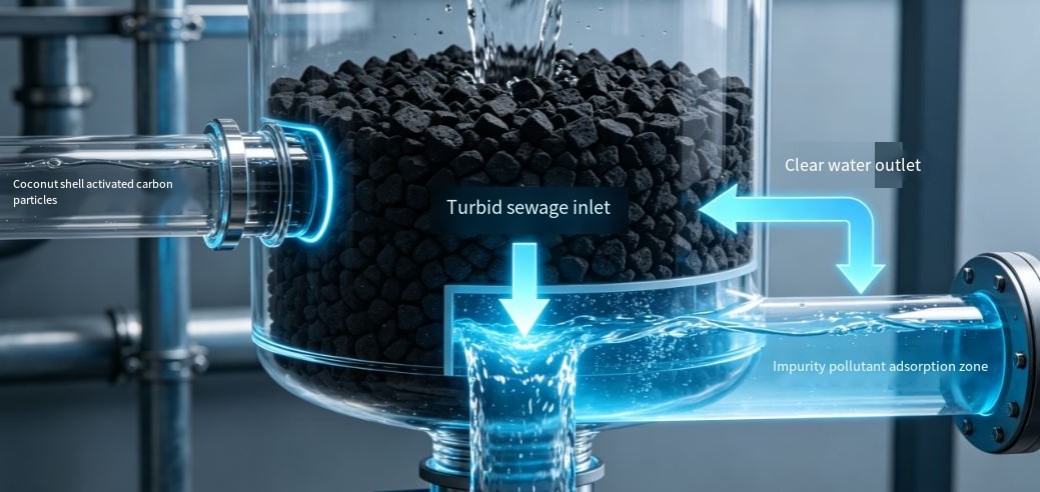
Both grades are manufactured from premium Southeast Asian coconut shell charcoal via high-temperature steam activation, featuring well-developed micropores and high abrasion resistance, fully compliant with international water treatment filter media standards from Clack. Key performance differences are shown in the table below:
|
Test Item |
Standard Requirement |
8×30 Mesh Coconut Carbon |
12×40 Mesh Coconut Carbon |
Engineering Implication |
|
Mesh Size |
Pass Sieve Test |
8–30 mesh |
12–40 mesh |
Finer particles of 12×40 mesh provide larger specific surface area per unit volume |
|
Iodine Adsorption Value |
≥1000 mg/g |
1050 mg/g |
1100 mg/g |
Higher iodine value enhances adsorption capacity for small-molecule COD and color-causing groups |
|
Methylene Blue Adsorption Value |
≥180 mg/g |
185 mg/g |
205 mg/g |
Direct indicator of decolorization efficiency; 12×40 mesh delivers over 10% better color removal |
|
Abrasion Hardness |
≥98% |
98% |
98% |
Resists pulverization under long-term water flow to avoid blockage of filter tank distributors |
|
Bulk Density |
420–520 g/L |
450g/L |
420 g/L |
Higher effective carbon loading in filter tanks of identical volume for 12×40 mesh |
|
Moisture Holding Capacity |
≥40% |
41% |
43% |
Better water retention extends hydraulic contact time between wastewater and carbon bed |
|
Ash Content |
≤3% |
3% |
3% |
Low ash eliminates heavy metal leaching risk and secondary water pollution |
|
Adsorption Saturation Cycle (Leachate COD=1000 mg/L Condition) |
Lab Measured Value |
Baseline |
+30% Longer |
Abundant microporous adsorption sites delay media exhaustion and reduce replacement frequency |
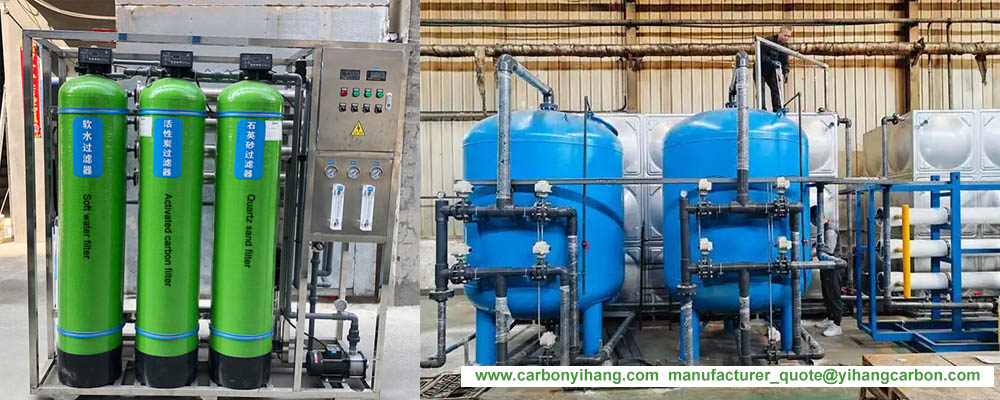
Coconut Shell Granular Activated Carbon Column Filter Tanks
The yellow-brown color of landfill leachate mainly originates from humic and fulvic acids, which are also the primary contributors to water COD. Coconut shell activated carbon features micropore-dominant structures that effectively capture such organic pollutants. The finer particle size of 12×40 mesh drastically multiplies adsorption sites per cubic unit of filter media.
On-site test condition: Leachate influent COD = 1000 mg/L, effluent standard requires COD ≤ 800 mg/L and complete color removal. Filter tanks filled with 12×40 mesh coconut carbon can consistently meet discharge limits, producing crystal-clear effluent with no visible discoloration.
Earlier projects using 12×30 mesh carbon experienced rapid saturation, requiring frequent shutdowns for backwashing and full media replacement. Parallel laboratory trials replacing media with 12×40 mesh coconut carbon demonstrated significantly slower saturation under identical organic loading. The service life of each carbon fill is extended by over 30%, greatly reducing expenditures on carbon replenishment, labor and production downtime.
Compared with the widely recommended coarse 8×30 mesh carbon: Larger particles have wider internal voids but far fewer effective micropores. Under high-concentration leachate loads, micropores saturate quickly, leading to early media failure. The smaller 12×40 mesh particles deliver massive additional adsorption sites, ideal for 24/7 continuous water production at landfill sites.
Clack’s official technical datasheet for coconut shell activated carbon filter media specifies two liquid-phase grades for vertical pressure filter tanks: 8×30 mesh and 12×40 mesh. The 12×40 mesh variant is optimized exclusively for high organic-load wastewater:
In contrast to coal-based granular activated carbon, coconut shell carbon contains over 90% micropores, ultra-low ash content and zero risk of heavy metal dissolution, preventing secondary contamination during leachate treatment. Industrial-grade coconut carbon maintains stable iodine values above 1000 mg/g, with superior selective adsorption for low-molecular organics, establishing it as the universally recognized premium filter media for advanced wastewater filtration.
 EN
EN