Jul 13,2026
Natural gas, refinery gas, and liquefied petroleum gas (LPG) commonly contain hydrogen sulfide (H2S) and carbon dioxide (CO2). These acidic gases must be removed before the gas can be transported or further processed. Among the available gas treatment technologies, amine absorption remains the most widely used because of its high removal efficiency and the ability to regenerate the solvent for continuous operation.
In modern gas sweetening plants, solvents such as MDEA (Methyldiethanolamine), DEA (Diethanolamine), and MEA (Monoethanolamine) continuously circulate between the absorber and the regenerator. Although these amine solvents are recyclable, they gradually become contaminated during long-term operation. Heavy hydrocarbons, degradation products, heat stable salts, corrosion particles, lubricating oils, and other impurities accumulate in the circulating solution. Once contamination reaches a certain level, the overall performance of the amine system begins to decline.
For this reason, activated carbon filtration has become a standard component in many amine treatment systems. Rather than removing H₂S directly, activated carbon maintains solvent cleanliness, allowing the amine solution to operate at its designed efficiency for a much longer period.
Every amine unit is exposed to contaminants from multiple sources. Feed gas often introduces condensable hydrocarbons, compressor oils, and fine solid particles. Meanwhile, internal corrosion generates iron sulfide and rust particles, while repeated heating during solvent regeneration gradually produces degradation compounds that dissolve into the amine solution.
Many of these contaminants cannot be removed by conventional mechanical filters because they are dissolved rather than suspended. As contamination increases, operators typically notice unstable foaming, reduced absorption efficiency, increased pressure drop, and higher solvent losses. In severe cases, excessive contamination may even force an unplanned shutdown for solvent replacement or equipment cleaning.
Among various amine solvents, MDEA is widely used because of its excellent selectivity for H₂S removal. However, long-term operation inevitably leads to the accumulation of hydrocarbons, heat stable salts, degradation products, iron particles, and other contaminants. These impurities not only reduce desulfurization efficiency but also create one of the biggest operational challenges in amine plants—amine foaming.
Amine foaming is one of the most common causes of operating losses. Severe foaming results in liquid carryover, higher differential pressure across absorbers and regenerators, reduced processing capacity, and poor mass transfer efficiency. Consequently, treated natural gas may fail to meet H₂S specifications. Large quantities of amine solution can also be carried downstream with the foam, causing continuous chemical losses. Operators are often forced to reduce plant throughput and continuously inject antifoaming chemicals, significantly increasing operating costs.
The primary causes of foaming are heavy hydrocarbons (C5+), lubricating oils, compressor oils, suspended solids, and amine degradation products. These substances act as surfactants, reducing the surface tension of the amine solution and promoting persistent foam formation.
Therefore, maintaining solvent quality is just as important as selecting the appropriate amine formulation.
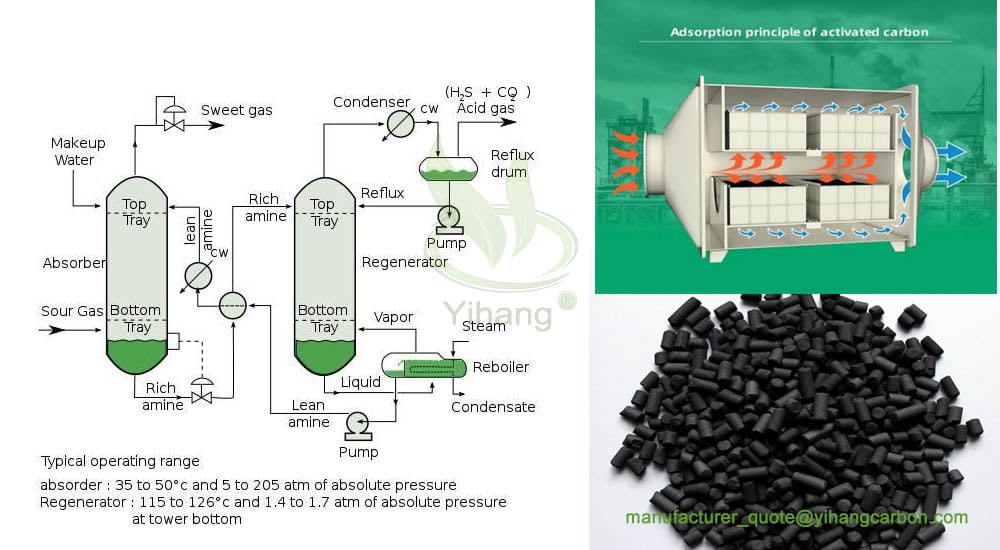
Granular activated carbon (GAC) is typically installed in a side-stream filtration loop, where a portion of the lean amine continuously passes through the activated carbon bed before returning to the process.
With its highly developed pore structure and enormous internal surface area, activated carbon effectively adsorbs a wide range of dissolved organic contaminants.
Unlike cartridge or bag filters, which primarily remove suspended solids, activated carbon captures hydrocarbons, degradation products, surfactants, organic acids, and other compounds responsible for solvent fouling. By continuously removing these impurities, activated carbon maintains solvent quality without interrupting plant operation.
Cleaner solvent not only improves gas treatment efficiency but also extends solvent service life, reduces replacement frequency, and lowers long-term operating costs.
In amine circulation systems, activated carbon adsorption is one of the most effective methods for preventing foaming and fouling. Instead of simply trapping particles, activated carbon removes contaminants through adsorption—a surface separation process driven by molecular interactions.
Activated carbon effectively removes heat stable salts, degradation products, hydrocarbons, foaming agents, and colored impurities from amine solutions. In MDEA systems, its primary function is to eliminate hydrocarbons and contaminants responsible for foam formation.
Foaming is one of the most common operational issues in amine treatment units. Stable foam reduces gas-liquid contact inside the absorber, lowering H2S and CO₂ removal efficiency while increasing solvent carryover and regeneration energy consumption.
Field experience consistently shows that excessive foaming is closely associated with the accumulation of organic contaminants in the solvent. Activated carbon effectively lowers the concentration of these compounds, making foam less stable and allowing bubbles to collapse more quickly.
Studies on contaminated MDEA solutions have demonstrated that sufficient contact between activated carbon and the solvent significantly improves contaminant removal efficiency. Plants equipped with effective activated carbon filtration generally experience fewer foaming incidents, more stable operation, and longer solvent service life.
Research also indicates that the defoaming performance of activated carbon depends directly on both contact time and dosage. A minimum contact time of approximately 15 minutes is generally required to achieve satisfactory contaminant removal and foam reduction. Increasing the activated carbon dosage further suppresses foaming, with studies reporting an almost linear relationship up to approximately 50 wt%. Surface tension measurements have confirmed that severely foaming MDEA solutions can be purified to an almost foam-free condition after proper activated carbon treatment.
Not all activated carbons perform equally in amine filtration applications. Adsorption efficiency depends on pore structure, raw material, mechanical strength, and particle size distribution.
A high-quality granular activated carbon should possess a well-developed pore network capable of adsorbing organic contaminants while maintaining excellent hardness to withstand continuous operation with minimal abrasion.
For refineries and natural gas processing plants, selecting the appropriate activated carbon directly affects purification performance. Key selection criteria include:
Iodine Number: Indicates adsorption capacity for small molecules. Activated carbon for amine filtration typically requires an iodine value above 900 mg/g, with higher iodine values generally providing better adsorption performance.
Pore Structure: This is the most critical factor. Heavy hydrocarbons, gums, and asphaltenes are relatively large molecules, making a well-developed mesoporous (2–50 nm) and macroporous (>50 nm) structure essential. Coconut shell activated carbon is rich in micropores and is ideal for adsorbing small degradation products, while coal-based pellet activated carbon offers a higher proportion of mesopores, making it more suitable for removing hydrocarbons and foaming substances. Excessive microporosity alone may become blocked by small molecules and reduce the adsorption of larger contaminants.
Mechanical Strength: In continuously circulating pressurized liquid systems, low-strength activated carbon easily breaks down into fines, which can worsen foaming and clog downstream precision filters. A hardness above 95% is generally recommended.
Surface Area: A specific surface area of at least 800 m²/g is recommended to ensure sufficient adsorption capacity, while premium products often exceed 1,000 m²/g.
Selecting the right activated carbon and regularly monitoring solvent quality can significantly improve filtration performance and extend service life.
In one large natural gas processing plant suffering from severe MDEA foaming, replacing the filtration media with 8*30 mesh granular activated carbon completely eliminated foaming, restored normal pressure differentials in both the absorber and regenerator, stabilized H2S levels within product gas specifications, reduced amine carryover losses by more than 70%, and dramatically lowered antifoam chemical consumption.
In another installation, coal-based activated carbon filter installed downstream of the amine circulation pump reduced foaming by 90%, improved overall system stability, and lowered regeneration energy consumption by approximately 15%. Industry reports also indicate that properly designed activated carbon filtration systems can reduce amine make-up costs by 15–30% while cutting unplanned shutdowns by nearly 50%.
Conclusion
Although activated carbon does not replace amine solvents for acid gas removal, it plays a vital role in maintaining solvent cleanliness and ensuring stable operation of gas sweetening units. By removing dissolved organic contaminants that mechanical filters cannot capture, activated carbon minimizes foaming, reduces fouling, improves gas treatment efficiency, and extends solvent life.
As natural gas processing facilities continue to focus on operational reliability and cost reduction, a properly designed activated carbon filtration system remains one of the most practical and cost-effective investments for maximizing the long-term performance of amine treatment plants.
 EN
EN