Jun 29,2026
Answer: Yes, in industrial and technical fields, "Activated Carbon" and "Activated Charcoal" generally refer to the same substance, and there is no essential difference between them in chemical and physical properties.
Both are carbon materials processed by special treatments (usually thermochemical treatment or steam activation), with highly developed pore structures (micropores, mesopores and macropores) inside. Their specific surface area can usually reach 500–2000 m²/g.
In daily conversations, "Activated Charcoal" is more often used to describe medical-grade activated carbon (such as products for poisoning first aid) or consumer goods (water purifiers, facial masks). In contrast, "Activated Carbon" is a broader and more professional industrial term that covers all application scenarios from gas-phase adsorption to liquid-phase decolorization.
Activated carbon and activated charcoal refer to the identical porous carbon material, with naming differences only resulting from regional usage habits.
There are no differences in raw materials, pore structure, adsorption capacity and technical indicators. Coconut shell based steam activated carbon can be referred to by either name interchangeably.
Activated carbon is non-toxic, non-explosive and hard to burn with high ash content after carbonization. Please follow the key notes below for storage and use. Contact us to download the full version for free.
Keep it dry, cool and ventilated, far from oxidants and heat sources. Moisture will weaken its adsorption ability.
MSDS (Material Safety Data Sheet) is a necessary safety file for exporting activated carbon, covering composition, hazards, storage, transport and emergency treatments. We have full MSDS for coal, wood and coconut shell steam activated carbon.
This is just a brief summary. Contact us to get the complete MSDS for free, which includes rules, environmental data and transport info.
Activated carbon uses fixed HS codes for global trade, sorted by raw materials and activation techniques.
Notes: The US, EU and other areas use extended 10-digit codes like 3802.10.00.00, while the first 6 digits 3802.10 apply worldwide. When exporting coconut shell steam activated carbon, fill in this code to avoid customs checks.
Old code 280300 is invalid. Coal, powder and column activated carbon all adopt 3802.10 series codes.
This product falls under HS 3802.10. Write "coconut shell raw material, steam activation, granular activated carbon" on invoices to eliminate customs classification conflicts.
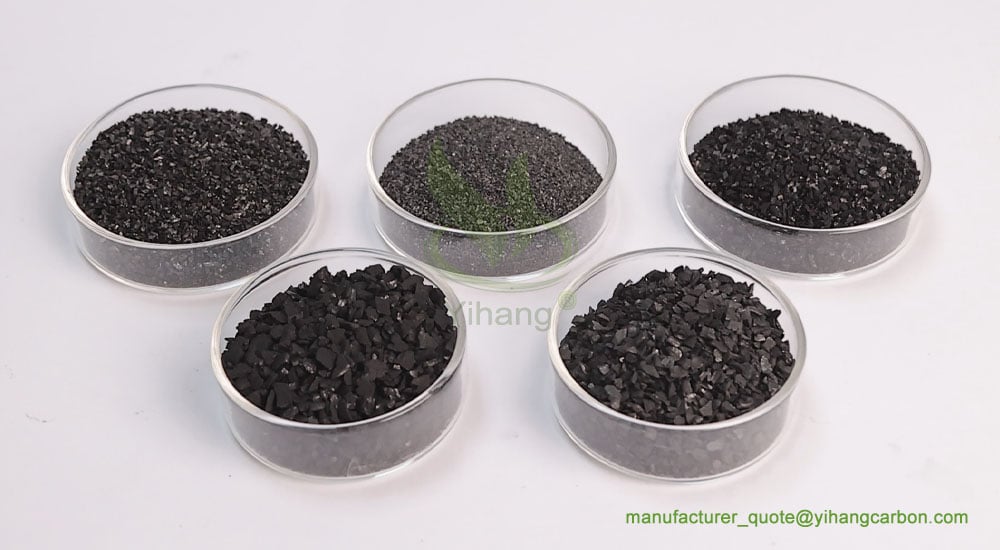
coconut shell activated carbon
Adsorption is the core performance of activated carbon. Its working process can be divided into three parts.
Massive micropores (below 2 nm) exist inside activated carbon. Strong van der Waals force from these pores firmly traps tiny molecules like organic pollutants, residual chlorine and odor particles in liquid or gas. Key indicators: Iodine value and specific surface area. Higher iodine value means more micropores and better adsorption of small molecules.
There are small amounts of oxygen-containing groups (carboxyl, carbonyl) on carbon surface. They absorb heavy metal ions and polar organics through chemical reaction or ion exchange.
Once pores are fully occupied by contaminants, activated carbon reaches adsorption saturation and loses adsorption capacity. It needs thermal/chemical regeneration or replacement.
After high-temperature steam activation, countless micro and meso pores form inside carbon particles, bringing an extremely large specific surface area. Physical adsorption captures organics, odors, VOCs, heavy metal ions and gold cyanide complexes from liquid and gas by van der Waals force. Coconut shell steam activated carbon has more micropores and better selective adsorption, ideal for gold extraction, drinking water purification and advanced waste gas treatment.
Activated carbon is widely used in liquid, gas and solid treatment industries.
Activated carbon prices vary widely, determined by raw material, specifications, activation method and market supply & demand. Below are standard domestic reference prices (USD per metric ton, tax included, freight excluded).
|
Type |
Standard Spec |
Reference Price (USD/MT) |
Typical Application |
|
Coal-based granular carbon |
Iodine value 800-1000 mg/g |
680 – 1090 |
Industrial waste gas, water treatment, large purification projects |
|
Coconut shell activated carbon |
Iodine value 1000-1200 mg/g |
1640 – 2730 |
Drinking water purification, pharmaceutical industry, high-end water filters |
|
Wood-based powdered carbon |
200-300 mesh |
550 – 820 |
Decolorization for sugar liquid & edible oil (disposable use) |
|
Honeycomb activated carbon |
Waterproof grade |
1090 – 1640 |
Industrial VOC treatment, spray booths |
|
High-end medical & food grade |
Meet USP/EP standards |
3420 – 6160 |
Pharmaceutical production, first aid, food additives |
To get accurate real-time quotations, please provide full details: application (water treatment / air purification), target pollutants (residual chlorine / formaldehyde removal), required iodine value and adsorption speed.
Prices fluctuate based on raw material, iodine value, particle size and order volume:
Contact us for the latest real-time quotation with attached SGS test reports.
Yihang Carbon is a professional Chinese activated carbon manufacturer and exporter with 30 years of production experience, ranking among China’s Top 10 activated carbon exporters. We mainly supply coconut shell steam activated carbon, coal-based activated carbon, wood powdered activated carbon and honeycomb activated carbon. All products come with official SGS third-party quality inspection certificates, meet international customs, USP/EP food-grade and industrial standards, with an annual export volume of 2500 metric tons. We support customized iodine value, particle size, packaging and OEM service, featuring competitive FOB price, stable quality and timely shipment. Global customers are warmly welcomed to contact us for free samples, complete MSDS documents and favorable wholesale quotations.
 EN
EN