This article comprehensively introduces KOH impregnated activated carbon, a high-efficiency adsorbent tailored for industrial H₂S and acidic gas removal. Modified via professional spray impregnation, it features dual physical and chemical adsorption for stable, deep desulfurization. Verified by YIHANG Carbon’s production data, the impregnation process causes over 5% material abrasion loss, making its unit price USD 450/ton higher than ordinary activated carbon. Despite higher costs, it delivers superior purification performance and longer service life, widely applicable to refineries, biogas purification, sewage treatment and other industrial scenarios with strict acid gas treatment demands.
What is KOH Impregnated Activated Carbon?
KOH impregnated activated carbon is a specially modified adsorption material produced by loading potassium hydroxide (strong alkaline medium) uniformly into the pore structure of finished coal-based or coconut shell activated carbon. Different from conventional activated carbon that only relies on physical pore trapping, it adopts a dual purification mechanism of physical adsorption + chemical alkaline neutralization. It is highly targeted for removing corrosive acidic gases including hydrogen sulfide (H₂S), sulfur oxides (SO2), nitrogen oxides (NOₓ), mercaptans, siloxanes and other acidic pollutants, widely used for continuous gas purification in refinery positive-pressure air systems and industrial environmental protection projects.
Industrial Production Process of activated carbon with KOH (4mm Coal-Based Pellet Type)
- Substrate selection: Use 4mm high-strength coal-based pellet activated carbon as the carrier. It has abundant micropores, stable mechanics and low air resistance, suitable for continuous industrial use.
- KOH solution mixing: Prepare 6%–20% potassium hydroxide solution per industrial flue gas treatment demands.
- Spray impregnation modification: Atomize and spray lye evenly onto carbon to infiltrate pores. It boosts efficiency and reduces excess water left by conventional soaking.
- Room-temperature curing: Pile impregnated carbon naturally for 48 hours to dissipate heat. Damp KOH-loaded carbon reacts with steam and exceeds 60°C, carrying risks of self-heating and spontaneous combustion.
- Drying and moisture regulation: Continuously air-dry the carbon, limiting final moisture to ≤8% (key delivery safety standard).
- Prompt sealed packing: Package qualified dry carbon right away with inner plastic film and outer woven bags to block air, stop moisture reuptake and keep KOH effective.
Production Cost & Loss Note (YIHANG Carbon Factory Statistical Data): The KOH impregnation process involves complex secondary processing procedures. During high-pressure spray and flipping treatment, the finished activated carbon produces inevitable surface abrasion and particle loss. The average weight loss rate after impregnation exceeds 5%. Combined with additional KOH chemical costs, manual processing fees, heat dissipation and drying energy consumption, quality inspection and sealed packaging costs, the overall production cost is significantly increased. Statistically, the average unit price of KOH impregnated activated carbon is approximately USD 450 per ton higher than ordinary non-impregnated activated carbon.

KOH Impregnated Activated Carbon Performance Comparison with Ordinary Activated Carbon
|
Comparison Item
|
Ordinary Activated Carbon
|
KOH Impregnated Activated Carbon
|
|
Adsorption Principle
|
Pure physical adsorption, reversible and easy to saturate and fail
|
Dual mechanism: physical adsorption + irreversible alkaline chemical neutralization
|
|
H₂S Removal Capacity
|
Extremely low breakthrough capacity, fails rapidly under high-concentration acid gas conditions
|
H₂S working adsorption capacity 15%–60%, stably treats high-concentration sulfide gas
|
|
Surface Property
|
Neutral/weakly acidic, no selective adsorption for acid gases
|
Strong alkalinity, targeted adsorption of corrosive gases such as H₂S, SOₓ, NOₓ
|
|
Ignition Risk
|
Extremely low spontaneous combustion risk
|
Lower ignition point; wet materials are prone to self-heating with strict safety control required
|
|
Application Scenarios
|
Conventional VOCs and odor purification
|
Refinery positive-pressure systems, continuous removal of corrosive acid waste gas
|
|
Comprehensive Cost
|
Low unit price, short service life, frequent replacement
|
USD 450/ton higher unit cost, longer service life, fewer replacements, lower long-term operation and maintenance cost for continuous industrial operation
|
Why Choose KOH-Impregnated Activated Carbon for H₂S Adsorption?
KOH-impregnated activated carbon is a high-efficiency adsorbent for industrial H₂S removal, suited for refinery normal-temperature continuous positive-pressure systems. Its dual physicochemical adsorption and alkaline modification outperforms conventional and other modified activated carbons.
Dual Physical & Chemical Adsorption for High-Efficiency H₂S Removal
Conventional activated carbon only relies on reversible physical adsorption and saturates quickly. KOH modification creates surface alkaline active sites, enabling synergistic physical enrichment and chemical fixation of H₂S. Micropores trap H₂S, while irreversible neutralization with KOH converts gaseous H₂S into solid potassium sulfide to avoid secondary emission (core reaction:$$2KOH+H_2S=K_2S+2H_2O$$). In oxygen-rich environments, the product further oxidizes into stable potassium sulfate, improving adsorption capacity and stability.
Excellent Industrial Cost-Performance
Three modified carbons are commonly used for acid gas treatment: KOH-impregnated, NaOH-impregnated and KI-impregnated carbon. KI-modified carbon has high activity but excessive cost for large-scale use; NaOH-modified carbon shows stable products but poor normal-temperature reaction efficiency, unable to support continuous high-efficiency purification in refineries.
Despite a USD 450/ton premium over standard activated carbon (caused by material loss, chemical consumption and production energy/labor costs), KOH-impregnated carbon delivers the best comprehensive cost performance. Its strong alkalinity and fast low-temperature reaction strike an optimal balance between high purification efficiency and economic cost, ideal for large-scale industrial H₂S treatment.
Broad-Spectrum Purification of Corrosive Acid Gases
This material adapts to complex refinery flue gas, achieving efficient H₂S removal and simultaneous purification of multiple corrosive pollutants including SOₓ, NOₓ, mercaptans, siloxanes and acid mists. It solves the single-defect problem of ordinary activated carbon, simplifies purification processes and prevents acid corrosion of pipelines and equipment.
Stable Adaptability for Normal-Temperature Continuous Operation
Optimized for refinery operating conditions (20–60°C, 40%–80% RH), the carbon maintains stable alkaline activity. Appropriate humidity hydrolyzes hard-to-remove organic sulfur (COS, CS₂) into H₂S for further fixed removal. The 4mm pellet structure ensures uniform airflow and low resistance, guaranteeing stable long-term continuous operation.
What are the main applications of KOH impregnated activated carbon?
KOH impregnated activated carbon features efficient hydrogen sulfide (H₂S) adsorption and multi-acid-gas purification performance. It is widely adopted in industrial scenarios for continuous corrosive acidic gas removal, with core application fields as follows:
Petroleum Refinery Industry (Core Scenario)
It purifies tail gas from sulfur recovery units, tank farm ventilation air, sewage tank waste gas and workshop positive-pressure air in refineries. The material removes H₂S, SOₓ and NOₓ, eliminates industrial odors, prevents acid corrosion of equipment and pipelines, and supports refineries in complying with environmental emission standards.
Biogas and Natural Gas Purification
It is used for desulfurization and impurity removal of biogas from landfills, breeding farms and industrial biogas projects. By removing H₂S and siloxane impurities, it protects gas generators and compressors from sulfur corrosion and boosts gas utilization efficiency.
Municipal Sewage and Waste Treatment
This material eliminates odor pollution caused by high-concentration H₂S in sewage aeration tanks and sludge dewatering workshops. Practical application proves it can lower H₂S concentration from 45ppm to below 1ppm, optimizing working environments and preventing equipment corrosion failure.
Chemical and Fertilizer Industry
It treats tail gas from nitric acid, phosphoric acid and chemical synthesis workshops. It neutralizes and adsorbs acidic fog droplets, sulfide and nitride pollutants, achieving clean industrial tail gas discharge.
Industrial Air Purification and Waste Incineration
It applies to deep purification of waste incineration flue gas, factory ventilation systems and underground pipe gallery gas filtration, removing acidic corrosive gases and toxic odorous VOCs.
Standard Technical Indexes of 4mm Coal-Based KOH Impregnated Activated Carbon
4mm coal-based pellet KOH impregnated activated carbon is the mainstream model for refinery H₂S adsorption and acid gas removal. All finished products must be equipped with official COA (Certificate of Analysis) and SGS third-party test reports, with mandatory detection indexes as follows :
|
Test Item
|
Standard Technical Parameters
|
Technical Description
|
|
Particle Specification
|
4mm pellet,
|
Balance airflow resistance and adsorption capacity, suitable for positive-pressure continuous systems
|
|
CCl4 Adsorption Rate
|
≥60%
|
Evaluate basic physical adsorption performance of pore structure
|
|
Iodine Value
|
≥1000mg/g
|
Ensure abundant micropores for gas enrichment
|
|
Specific Surface Area
|
≥1100m²/g
|
Provide sufficient reaction sites for H₂S chemical adsorption
|
|
Mechanical Hardness
|
≥85%
|
Avoid pulverization under airflow scouring, prevent system blockage
|
|
Bulk Density
|
0.55–0.65g/cm³
|
Stable filling capacity for industrial filter tanks
|
|
KOH Impregnation Content
|
6%–20% (customizable)
|
10%–15% recommended for refinery high-concentration H₂S working conditions
|
|
Finished Moisture
|
≤8%
|
Core safety index to avoid self-heating and spontaneous combustion
|
|
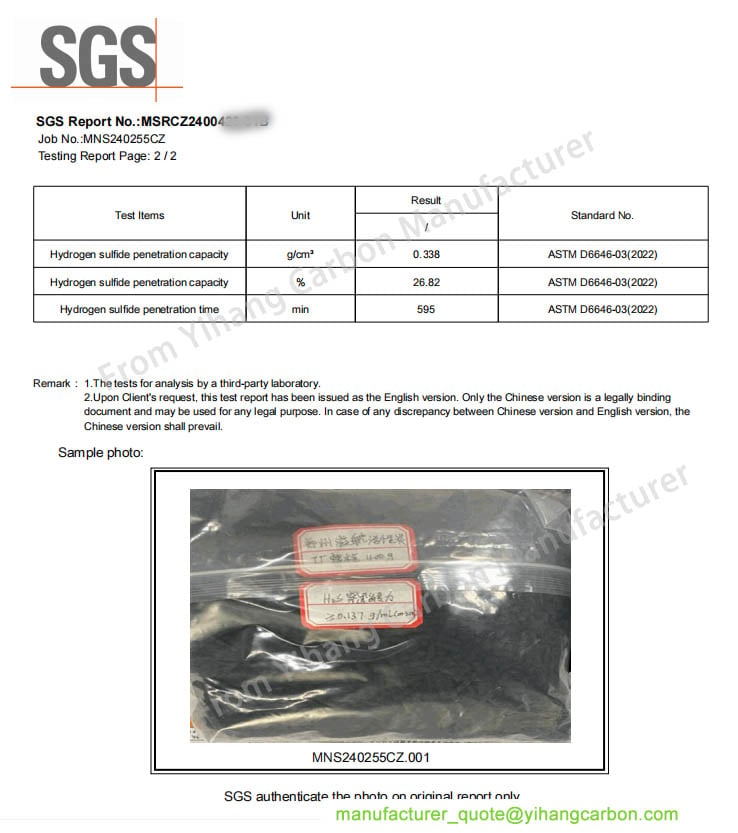
H₂S Breakthrough Capacity
|
≥0.338g/cc
|
Key index to determine service life and replacement cycle
|
|
H₂S Working Capacity
|
15%–60%
|
Maximum effective H₂S adsorption load per unit carbon
|
How to Select Suitable KOH Impregnated Activated Carbon
Selection Based on H₂S Concentration of Operating Conditions
- Low H₂S concentration (<500ppm): Adopt 4mm pellet carbon with 6%–8% KOH loading and CCl₄ adsorption rate ≥60%, with cost efficiency as the top priority.
- Medium-to-high H₂S concentration (500–2000ppm, mainstream for refineries): Select carbon with 10%–12% KOH loading and H₂S breakthrough capacity ≥0.14g/cc, fit for long-term continuous positive-pressure operation.
- Severe high-concentration condition (>2000ppm): Adopt products with high KOH loading of 15%–20%. Front-end pretreatment equipment is required to cut inlet gas load and prolong service life.
Principles for Substrate Selection
4mm coal-based pellet activated carbon is the preferred substrate for refinery systems. It boasts high mechanical strength, good resistance to air flow erosion, stable packing density and low system pressure drop.
Coconut shell granular carbon has abundant micropores yet poor mechanical strength. It tends to pulverize after long-term erosion under positive pressure. It is only applicable to purification equipment with small air flow and low load, and cannot be used in large continuous refinery treatment systems.
Mandatory Qualification Requirements
For industrial procurement, suppliers shall provide complete and valid documents to guarantee product performance and safety, including official factory COA (covering core indicators: KOH content, H₂S adsorption capacity, moisture content, hardness, etc.), SGS third-party test certificate, and SDS for transportation and safe operation guidance.
Main Global & Domestic Suppliers
Professional Export-Grade Manufacturers (Suitable for Overseas Refinery Projects)
Heycarbons: A professional manufacturer focusing on KOH impregnated activated carbon, providing customizable KOH concentration and CTC index products. It supports complete COA and SGS certification, and has professional overseas transportation teams to solve the self-heating transportation risk of impregnated carbon, widely supplied to European and American refinery and biogas projects .
Recofiltration: Specializes in impregnated carbon series products, its PAC-KoH-4mm pellet carbon is specially designed for H₂S and SOₓ removal, suitable for low-resistance continuous gas purification systems, with standardized industrial odor control grade performance .
Yihang arbon: Professional Chinese factory focusing on alkaline impregnated carbon modification and production. It provides accurate industrial production data of material loss and cost premium in impregnation process, and supplies stable 4mm KOH impregnated activated carbon for global refinery acid gas treatment projects .
Professional Storage and Transportation Specifications for KOH Impregnated Activated Carbon
KOH impregnated activated carbon is susceptible to self-heating and moisture absorption, requiring stringent storage and transportation standards to guarantee product performance and operational safety.
Storage Specifications
-
Warehouse Environment: Store in a cool, dry and enclosed warehouse with an ambient temperature of ≤30°C. Keep the product away from heat sources, steam pipelines and acidic materials. Outdoor stacking is prohibited.
-
Packaging Requirements: Keep the original double-layer sealed packaging (inner plastic lining + outer woven/ton bag) intact. Products with damaged packaging are not allowed to be stored to prevent moisture reabsorption and KOH failure.
-
Stacking and Safety: Stack products in a single layer with heat dissipation gaps reserved. Equip the warehouse with dry powder and CO₂ fire extinguishers. Water spray cooling is strictly forbidden.
-
Storage Cycle: Use the product within 6 months under sealed conditions. Long-term storage will cause KOH to react with carbon dioxide in the air and reduce the hydrogen sulfide adsorption capacity.
Transportation Risks and Solutions
The primary transportation hazard of this product is self-heating spontaneous combustion. When the moisture content exceeds 8%, the reaction between KOH and water vapor generates continuous heat, leading to heat accumulation and spontaneous combustion. Due to high safety risks, the product incurs higher freight and port operation costs than ordinary activated carbon and is rejected by most shipping companies.
-
Overall Transportation Plan: Prioritize full-package transportation by suppliers qualified for self-heating hazardous goods, covering heat dissipation treatment, sealed packaging and hazardous material appraisal procedures.
-
Land Transportation: Adopt temperature-controlled enclosed vans, avoid transportation during high-temperature daytime hours, and conduct regular temperature inspections during transit.
-
Sea Transportation: Complete the UN classification appraisal for self-heating substances in advance. Equip ton bags with heat-insulating and moisture-proof films, and store them in independent cabin areas away from flammable goods.
-
Loading and Unloading: Handle the product with care to avoid packaging damage and frictional heating of carbon particles. Dragging and treading on goods are prohibited.
Contact an Activated Carbon Manufacturer
FAQs
Can damp and self-heating KOH impregnated carbon be reused?
No. Damp carbon will cause KOH alkaline components to be consumed and pore structures to be blocked by water vapor, resulting in a sharp decline in H₂S adsorption capacity. Meanwhile, the self-heating state has continuous fire hazards. It can only be reused after professional re-drying and index re-inspection, and unqualified products must be scrapped directly.
Is KOH impregnated carbon renewable after H₂S adsorption saturation?
It is not recommended for regeneration in refinery high-load working conditions. H₂S reacts with KOH to form stable solid sulfide and sulfate, which are firmly attached to the pore structure and cannot be completely removed by conventional water washing or high-temperature regeneration. Only low-concentration light-load scenarios support shallow regeneration, and industrial continuous operation requires regular replacement .
What is the difference between KOH and NaOH impregnated carbon for H₂S removal?
KOH impregnated carbon is more suitable for refinery normal-temperature continuous operation, with stronger alkalinity, faster low-temperature H₂S reaction speed and higher purification efficiency. NaOH impregnated carbon has more stable reaction products and is suitable for working conditions with large temperature fluctuations and high CO₂ concentration, but its normal-temperature desulfurization efficiency is lower than KOH modified carbon .
Will CO₂ in flue gas affect H₂S adsorption effect?
Yes. CO₂ is an acidic gas that will preferentially consume the alkaline active sites on the carbon surface, reducing the H₂S adsorption capacity. For refinery flue gas with high CO₂ content, it is recommended to use high-load KOH impregnated carbon or install front-end CO₂ pretreatment equipment.
Why does the system pressure drop rise rapidly after filling?
The main reasons are insufficient carbon hardness leading to pulverization and blockage under airflow scouring, or excessive dust and oil mist in the inlet gas blocking the pore structure. The solution is to select qualified products with hardness ≥95% and install front-end dust and oil removal pretreatment filters.
What personal protection is required during operation?
KOH is strongly corrosive. Operators must wear alkali-resistant gloves, goggles and dust-proof masks to avoid direct contact with skin and respiratory tract. In case of accidental contact, rinse with plenty of clean water immediately.
References
[1] Heycarbons. KOH Impregnated Activated Carbon[EB/OL]. https://heycarbons.com/koh-impregnated-activated-carbon/
[2] Industrial Odor Control. GC-IPH KOH Impregnated Activated Carbon[EB/OL]. https://www.industrialodorcontrol.com/gc-iph-koh-impregnated-activated-carbon.html
[3] Félix MériméBkangmo Kontchouo. Activation of biomass (cola nut shell) with KOH and K₂C₂O₄[J]. Journal of the Energy Institute,2023, S1743967123001174
[4] YIHANG Carbon. Industrial Production Data of Modified Impregnated Activated Carbon[EB/OL]. https://yihangcarbon.com
 EN
EN